
Should You Buy Car Parts From Canadian Retailers?
Last Updated: October 31, 2026
Quick Summary
Choosing canadian retailers removes the customs duty, brokerage fee, and currency conversion that come with a cross-border order, so the price you see at checkout is the price you pay. A domestic order also moves through a domestic courier network with fewer handoffs and fewer places for a box to sit.
- Landed cost is item price plus shipping plus sales tax, with no duty or brokerage on a domestic shipment.
- The only variable across provinces is the tax rate; item price and shipping stay identical.
- Compare final totals, not sticker prices, because cross-border figures often exclude duty, brokerage, and tax.
- Match the part to your VIN, not the model name, since trim, engine code, and production date split parts.
- Buy domestically when the part is heavy, bulky, or time-sensitive to avoid the cross-border layer.
Table of Contents
- What Buying From Canadian Retailers Actually Saves You
- How the Best Online Auto Parts Stores in Canada Compare
- Landed Cost: What You Actually Pay at Checkout
- Auto Parts Shipping and Delivery: Speed, Couriers, and Damaged Boxes
- Auto Parts Return Policy: What to Check Before You Click Buy
- Aftermarket Parts Fitment Guide: Getting the Right Part First Time
- Which Parts to Buy Domestically and Which to Import
- Check Fitment and Order From a Canadian Retailer
- Frequently Asked Questions
What Buying From Canadian Retailers Actually Saves You
Buying from a Canadian retailer removes the customs duty, brokerage fee, and currency conversion that come with a cross-border order. That is the core saving, and it is bigger than most shoppers expect. At My Parts Guy MPG Auto, we ship from within Canada, so the price you see at checkout is the price you pay.
The second saving is time. A domestic order moves through a domestic courier network, which means fewer handoffs and fewer places for a box to sit.
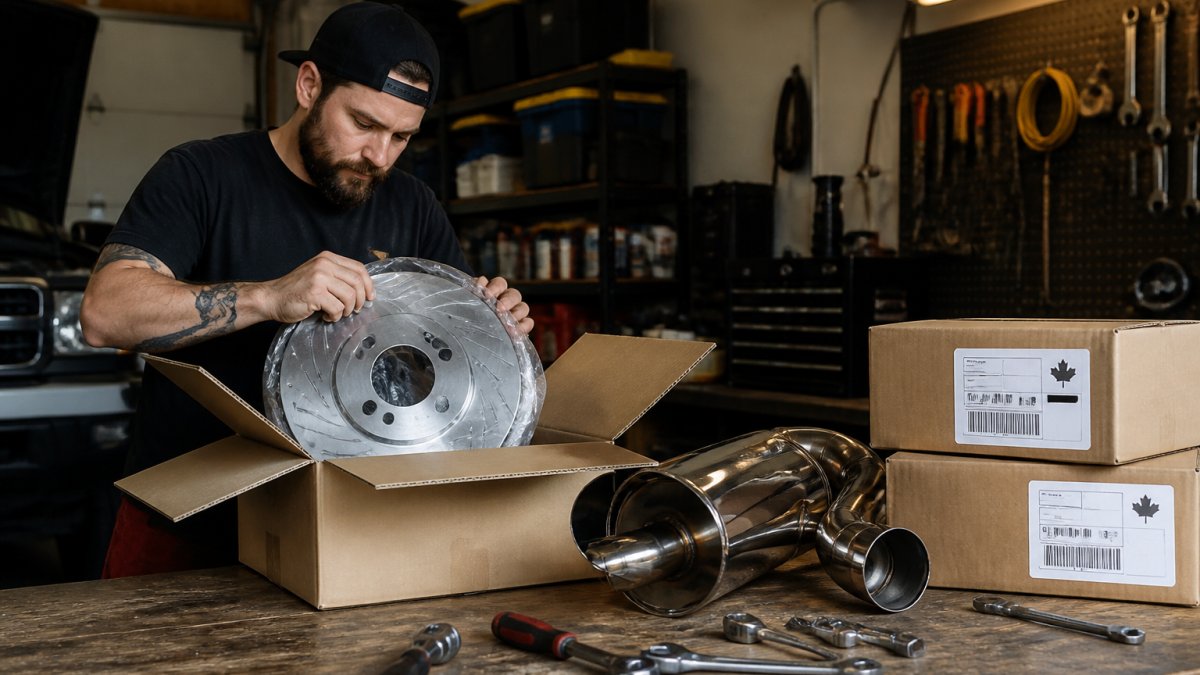
What a domestic retailer does not automatically give you is a better price. Some cross-border sellers list lower sticker prices, and that gap is real. The question is whether it survives the landed cost calculation, which we get to below.
How the Best Online Auto Parts Stores in Canada Compare
The best online auto parts stores in Canada separate themselves on four things: catalog accuracy, landed cost transparency, delivery reliability, and what happens after a part arrives wrong. Price matters, but price without those four is a trap.
Here is how the criteria stack up when you are evaluating any Canadian retailer, including us:
| Criterion | What Good Looks Like | Warning Sign |
|---|---|---|
| Catalog accuracy | Fitment data tied to trim and engine code | "Universal" claims with no fitment filter |
| Landed cost | Final price shown before payment | Fees appear at the payment step |
| Delivery | Domestic courier, tracking from day one | Vague multi-week windows |
| Returns | Written policy, clear window, restocking terms stated | Policy only available by email |
| Support | A person who knows the catalog | Chatbot with no parts knowledge |
For a wider view of how Canadian retailers stack up against each other, our breakdown of the best PartsAvatar alternatives for Canadian enthusiasts covers the field in more detail.
What Separates a Good Parts Retailer From a Cheap One
A good retailer tells you when a part will not fit. A cheap one lets you find out yourself.
That single behavior explains most of the difference in buyer experience.
Landed Cost: What You Actually Pay at Checkout
Landed cost is the total you pay to get a part into your hands: item price, shipping, sales tax, and any duty or brokerage. A domestic Canadian order normally carries the first three and skips the last two.
Cross-border orders add customs duty where applicable, a brokerage fee charged by the carrier to clear the shipment, and often a currency conversion spread.
If surprise fees are your main worry, our guide to whether Canadian auto parts shipping is really free of surprise fees walks through what to check before you pay.
Province-by-Province Landed Cost Examples
Landed cost varies by province mainly through the sales tax rate applied at checkout. The structure is the same everywhere: item price, plus shipping, plus the applicable sales tax, with no duty or brokerage on a domestic shipment.
To make that concrete, here are three representative baskets priced the way a domestic checkout would present them.
| Basket | Item price | Shipping | Tax applied at checkout | Landed total |
|---|---|---|---|---|
| Single brake rotor (parcel) | $89.00 | $14.95 | 5% GST (AB) | $109.15 |
| Single brake rotor (parcel) | $89.00 | $14.95 | 13% HST (ON) | $117.47 |
| Front pads + rotors kit (parcel) | $219.00 | $0.00 (free-shipping threshold met) | 15% HST (NS) | $251.85 |
| Cat-back exhaust (freight) | $649.00 | $89.00 (freight surcharge) | 12% HST (BC) | $826.56 |
The pattern to notice: the item price and shipping are identical across provinces, and the only variable is the tax rate. That is the domestic advantage in one table. A cross-border order of the same rotor would add duty (where applicable), a carrier brokerage fee typically charged per shipment, and a currency conversion spread, and those are often collected at the door rather than shown at checkout.
Once you have seen the gap, our step-by-step guide on how to avoid duty fees covers the practical moves that keep the landed cost predictable.
Auto Parts Shipping and Delivery: Speed, Couriers, and Damaged Boxes
Damaged boxes are the other reality. Check the carton before you sign, photograph any crush damage, and report it the same day. A retailer with a real returns process will resolve it; a retailer without one will stall. For a closer look at timelines, read how long performance parts take to ship to Canada.
Auto Parts Return Policy: What to Check Before You Click Buy
Read the return policy before you add to cart, not after the part arrives. Four details decide whether a return is painless or painful:
- **
- **
- **
- **
A common mistake is assuming a return policy covers fitment errors. Many do not, which is why getting fitment right the first time matters more than any return window.
Aftermarket Parts Fitment Guide: Getting the Right Part First Time
The aftermarket parts fitment guide rule is simple: match the part to your VIN, not to the model name. Trim level, engine code, and production date split parts that look identical in a photo.
For a BMW owner, that means knowing your engine code before you order anything engine-adjacent. For a truck owner, it means checking cab configuration and bed length. These details can change the part number.
How to Verify Fitment Before You Buy
A fitment check is a sequence, not a single lookup. Run it in this order:
- Decode the VIN. The 17-character VIN encodes model year, plant, engine, and trim. Any retailer that asks for the full VIN is doing this step for you.
- Confirm the engine code. Two cars of the same model year can carry different engines with different mounting points, sensors, and clearances. The engine code, not the displacement, is what the catalog keys on.
- Check the production split. Mid-year changes are common. A part that fits a vehicle built before a certain month may not fit one built after. Ask for the production date range on the listing.
- Cross-reference the OEM number. The original part number on the listing should match the number on the part you are replacing, or be a documented supersession of it.
- Read the fitment notes, not just the fitment filter. Notes flag exceptions, "excludes models with sport suspension," "requires adapter harness", that a green checkmark will not show.
When a Part Doesn't Fit: Resolution Steps
- Stop the install and photograph the part against the mounting point.
- Note your VIN and the part number on the box.
- Contact the retailer with both before you modify anything.
- Do not force-fit, grind, or drill. Modification usually voids the return.
- Ask for a written resolution: replacement, exchange, or refund.
Which Parts to Buy Domestically and Which to Import
Buy domestically when the part is heavy, bulky, or time-sensitive. Rotors, exhausts, and accessories cost real money to move, and a domestic order avoids the cross-border layer entirely.
Run the full calculation, not the sticker price. Our guide to buying performance parts without hidden fees covers how to structure that comparison.
For most maintenance and performance needs, the domestic route wins on predictability. That is the trade: you may pay slightly more up front and you stop paying in surprises.
Check Fitment and Order From a Canadian Retailer
The challenge is not finding parts. It is finding a retailer that gets the fitment right, quotes a final price, and answers the phone when something goes sideways.
At My Parts Guy MPG Auto, we are located in Canada with no duties or brokerage fees. We monitor competitor pricing to keep ours competitive. And our team brings decades of automotive knowledge to part selection, so you can ask a person for help. Customers like Junior AZ have praised our service: "John was very professional and very helpful... customer service was the best I've ever received from any parts store." That same attention to knowledgeable help can make comparing options such as Flako performance house part of choosing parts with confidence.
Get started with My Parts Guy MPG Auto and order the part that fits the first time.
Frequently Asked Questions
Are auto parts cheaper from Canadian or U.S. retailers?
The sticker price on a U.S. site often looks lower, but the gap narrows once you add currency conversion, cross-border shipping, customs duty, and brokerage fees. Compare the total at checkout, not the headline price, before deciding.
How do I check whether an aftermarket part fits my vehicle?
Use the retailer's fitment tool and enter your exact year, make, model, trim, and engine code. For BMW N55, B58, and S58 cars, the engine code matters more than the badge. Cross-check the manufacturer part number against your original component, A quick email to support with your VIN before ordering catches most mismatches.
How can I avoid unexpected fees when ordering auto parts online?
Buy from a retailer that ships domestically. Ask whether sales tax is included at checkout or added later, and confirm the courier. If you order cross-border, budget for customs duty, sales tax, and a brokerage charge, which can add a meaningful percentage to heavy or oversized parts. Get the landed cost in writing before you pay.
What should I look for in an auto parts return policy?
Check the return window, whether opened or installed parts qualify, who pays return shipping, and how wrong-fit claims are handled. A workable policy covers fitment errors, not just damaged goods. Keep original packaging until the part is installed and working.
