
How Long Do Performance Parts Take to Ship to Canada?
Last Updated: October 29, 2026
Quick Summary
Performance parts shipping to Canada depends on two separate clocks: order processing time before the parcel leaves the warehouse, and shipping transit time with the courier. No single delivery number exists, because warehouse location, shipping zone, and whether the part is in stock or special-order can make two orders placed the same morning arrive a week apart.
- In-stock items ship within the normal processing window; special-order items wait until the supplier delivers them.
- A tracking status stuck at label created means processing, not a courier delay.
- Backorders have no confirmed date and can drift for months, so avoid them for time-sensitive projects.
- Courier brokerage fees are billed separately from duty and tax and can arrive weeks after delivery.
- Buying from a seller shipping within Canada avoids duties and brokerage fees entirely.
Table of Contents
- What Drives Performance Parts Delivery Time
- In-Stock vs. Special-Order Auto Parts: What Changes
- Why Performance Parts Go on Backorder (and What to Do)
- Customs, Duties, and Brokerage Fees for Cross-Border Orders
- How to Track an Auto Parts Order Step by Step
- Shipping Costs, Surcharges, and Packaging That Affect Your Bill
- Ordering Performance Parts With No Duties or Brokerage Fees
- Frequently Asked Questions
What Drives Performance Parts Delivery Time
Performance parts shipping times to Canada depend on two separate clocks: how fast the seller picks and packs your order, and how long the parcel spends in transit. Most buyers only think about the second one.
Order processing time is the gap between your payment clearing and the box leaving the warehouse.
Shipping transit is the time with the courier. That depends on where the warehouse sits, how far you are from it, and which service level you paid for.
So when someone asks how long performance parts shipping takes, the honest answer is that no single number exists. Two orders placed the same morning can arrive a week apart.
Order Processing vs. Transit Time
Processing and transit are different phases, and only one of them is the courier's fault.
- Processing: order verification, payment authorization, picking, packing, labeling
- Transit: courier pickup, line-haul between depots, local sorting, last-mile delivery
A common mistake is blaming the courier for a delay that happened before pickup. If your tracking number sits at "label created" for three days, the parcel has not moved yet. That is a warehouse issue, not a carrier one.
Check the tracking status before you call anyone. "Label created" means processing. "In transit" means the courier has it.
Warehouse Location and Shipping Zones
Where the parts ship from shapes the delivery lead time more than anything else. A parcel moving within the same province usually clears faster than one crossing the country.
Shipping zones work like rings around the warehouse. The closer you are, the shorter the shipping transit. Rural delivery adds another leg at the end, and that last stretch is often the slowest part of the trip.
If you are ordering from a remote area, build extra days into your plan. That is not pessimism. It is how parcel networks work.
In-Stock vs. Special-Order Auto Parts: What Changes
In-stock inventory ships within the normal processing window.
That single difference explains most of the gap in performance parts delivery time. An in-stock exhaust component might leave the same day.
Ask one question before you buy: is this on the shelf, or is it being ordered in? A good retailer answers plainly.
Competition Bureau Canada guidance on misleading delivery claims requires sellers to be honest about when goods will arrive. You are entitled to a straight answer.
If you are weighing a longer wait against value, it helps to see which performance parts offer the best value before you commit to a special order.
| Order Type | Clock Starts | Typical Wait | Best For |
|---|---|---|---|
| In-stock | At order processing | Shortest | Repairs, planned upgrades |
| Special-order | When supplier ships | Longer, variable | Rare or built-to-order parts |
| Backorder | Unknown | Longest, open-ended | Non-urgent projects |
Why Performance Parts Go on Backorder (and What to Do)
A backorder means the seller has sold out and is waiting on more stock. The performance parts backorder problem hits popular platforms hardest, because demand outruns supply on the parts everyone wants.
Supply chain delays make it worse. A single missing component at a factory can hold up a whole production run. Nobody at the retail end can speed that up.
Here is how to handle it:
- Ask for a real restock date, not "soon."
- Find out whether your payment is charged now or on shipment.
- Check the return policy in case the wait is too long.
- Consider an in-stock alternative that does the same job.
Watch out: a backorder with no confirmed date can drift for months. If a project is time-sensitive, do not gamble on an open-ended estimate.
Customs, Duties, and Brokerage Fees for Cross-Border Orders
Cross-border orders bring customs clearance into the picture, and that is where surprise charges appear. A parcel crossing an international border can attract duties and taxes, plus a brokerage fee from the carrier handling the paperwork. The mechanics matter more than the warning, so here is how clearance actually works.
The Two Clearance Streams
Most parcels enter through one of two streams, and the stream determines who charges you and how much.
- Postal stream (Canada Post and its foreign counterparts): the parcel is presented to the Canada Border Services Agency for assessment. Canada Post collects any duty and tax at delivery, and may apply a handling fee.
- Courier stream (UPS, FedEx, DHL, Purolator): the carrier clears the shipment through its own brokerage arm or a third-party broker. Courier brokerage fees are billed separately from duty and tax, so check how your carrier charges them. This is the fee buyers resent most, because it can arrive weeks after delivery.
The Low-Value Shipment Threshold
Cross-border shoppers often ask about the duty-free threshold. Canada has low-value relief thresholds for courier and postal imports, and duty and tax may apply above them (Increase to low-value shipment thresholds and other changes). Confirm the current figures and rules with the Canada Border Services Agency before you order.
Confirm the current rules on the CBSA site before you order.
How to Reduce or Avoid Brokerage
There are legitimate ways to shrink the cross-border cost:
- **Ask the seller whether shipping by postal service is available instead of an express courier.
- Confirm the Incoterm. If the seller ships DDP (delivered duty paid), duties and brokerage are baked into the price. If it ships DAP (delivered at place), you pay them on delivery.
- Self-clear where permitted. Some carriers allow you to clear the shipment yourself at a CBSA office, which removes the brokerage fee but costs you time.
- Buy from a seller already shipping within the country. When the goods are already here, there is no customs clearance at the border.
For a wider look at ordering across borders, see our guide to buying performance truck accessories online.
Carrier Reliability and Last-Mile Delivery
Carrier service levels vary, and last-mile delivery can affect how your parcel arrives.
For heavy automotive parts, the carrier choice matters more than for a small parcel because weight and dimensions push the shipment into different service tiers. A common pattern among buyers:
Courier services can differ in rural coverage and tracking detail. Ask which carrier a seller uses and check reviews for your area.
How to Track an Auto Parts Order Step by Step
Tracking an auto parts order means following it from processing to delivery. The tracking number is your proof of where the parcel actually is.
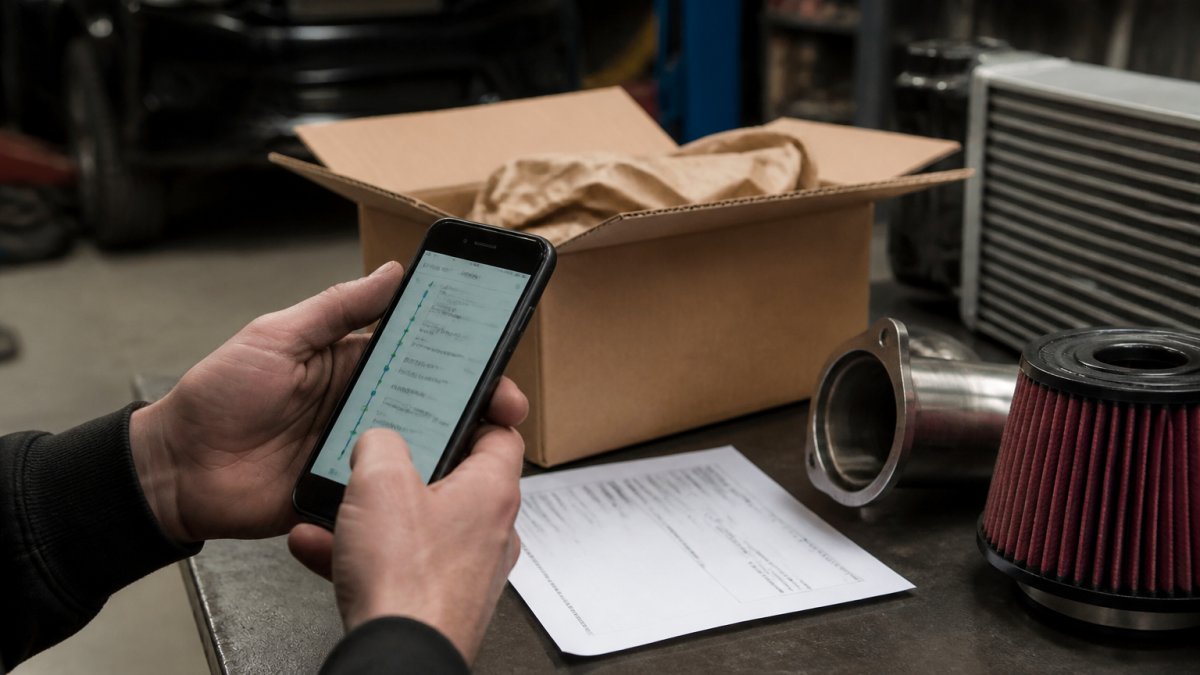
Here is the sequence:
- Get the tracking number from your order confirmation or account page.
- Enter it on the carrier's site, not just the seller's tracking widget.
- Read the status carefully. "Label created" means processing. "In transit" means moving.
- Watch for "out for delivery" on the final day.
- Check the delivery address if a scan shows a problem.
- Contact the seller first if the parcel stalls, since they can open a trace with the courier.
A tracking number that never updates is a red flag. Give it a couple of business days, then ask the seller to investigate.
Shipping Costs, Surcharges, and Packaging That Affect Your Bill
Shipping costs are built from more than distance. Parcel dimensions and weight drive the base rate, and shipping surcharges stack on top. For performance parts, the packaging itself is often the biggest variable, and no competitor explains it, so here is the breakdown.
Billable Weight vs. Actual Weight
Carriers often charge on the greater of actual weight or dimensional (dim) weight, which is calculated from a parcel's dimensions.
The Surcharges That Stack
Carriers may apply surcharges such as oversize, handling, weight, remote-area and fuel charges. Check with your carrier which ones apply to your order.
How Packaging Affects Speed, Not Just Cost
Packaging is not only a billing issue. Packaging can affect how a parcel is handled, so ask the seller how the part is packed.
The practical rule: ask the seller how the part is packed and whether the packed dimensions cross an oversize threshold.
What This Means for Your Delivery Estimate
A heavy or oversize part shipped to a rural address should be planned with extra days, not just extra cost. The surcharges tell you the parcel is in a slower, more handling-intensive lane. Build that into your timeline before you order.
Ordering Performance Parts With No Duties or Brokerage Fees
The cleanest way to avoid customs charges is to buy from a seller based in the country you live in.
That is the model at My Parts Guy MPG Auto. We ship from within Canada, so you pay no duties and no brokerage fees. We also monitor competitor pricing to keep our numbers competitive.
As Vincent Gagnon put it, "Mandy reached out to me via e-mail to help out. She was absolutely amazing."
Before you order anywhere, run this checklist:
- Is the seller shipping from within the country?
- Are duties and brokerage fees included or excluded?
- Is the part in stock or special-order?
- Is there a tracking number and a clear delivery estimate?
- Is return shipping explained up front?
Answer those five and you will avoid most of the delays and surprise fees that make performance parts shipping feel unpredictable.
Frequently Asked Questions
How long does it usually take for performance parts to arrive?
Delivery time depends on your province, the carrier's service level, and whether the part is in stock. Special-order items add supplier lead time before dispatch, so check the stated delivery estimate on the product page. Cross-border orders may add a few days if customs clearance is required. Always check the stated delivery lead time on the product page and factor in order processing time separately from shipping transit.
What affects shipping times for performance parts?
Five things matter most: whether the part is in stock or special-order, the warehouse location relative to your shipping zone, the carrier service level chosen, customs clearance for cross-border shipments, and parcel dimensions or weight that trigger freight shipping. Rural delivery can also add a day or two versus urban addresses. Supply chain delays at the supplier level affect special-order items most, so confirm stock status before you buy.
Can customs processing affect delivery times for parts shipped internationally?
Yes. When a parcel crosses the border, it may be held for customs clearance, which can add time depending on documentation and volume. Duties and taxes, plus brokerage fees charged by the courier, are assessed at that stage. Ordering from a Canadian warehouse avoids this step entirely, which is why many enthusiasts prioritize domestic shipping for performance parts.
What should I do if my auto parts order is delayed?
First, check the tracking number for the last scan and confirm whether the parcel is in transit, held at customs, or stuck at a distribution center. Then contact the retailer with your order number so they can open a trace with the courier. If the delay is a backorder, ask for a revised ship date or a partial shipment. Keep records of all correspondence in case you need to file a shipping insurance claim or request a refund.
Ordering performance parts should not mean guessing at delivery dates or bracing for a customs bill at the door. My Parts Guy MPG Auto ships from within Canada with no duties or brokerage fees, backs every order with decades of automotive knowledge, and keeps pricing competitive through constant competitor monitoring. Get started with My Parts Guy MPG Auto and spend your time on the build, not on tracking a parcel.
