
Is Shipping Auto Parts in Canada Really Free of Surprise Fees?
Last Updated: October 25, 2026
Quick Summary
Auto parts shipping is the total delivered cost of moving a component from a warehouse to your door, bundling the carrier base rate, fuel and handling surcharges, accessorial fees, and any applicable tax. Free-shipping thresholds usually waive only the base rate, so oversize, freight, remote, and expedited charges can still apply. Always ask for the all-in delivered figure before you commit.
- Free shipping is a threshold offer that typically excludes exhaust systems, body panels, wheels, and freight items.
- Parcel shipments to major urban centers often arrive within a few business days, while freight to the same city takes longer.
- Rural and northern addresses add days because carriers run fewer routes and consolidate shipments.
- Brokerage is the customs fee buyers miss most, and it can make a cross-border part cost more than a domestic one.
- Confirm fitment with your VIN and get support to verify the part number in writing before paying.
Table of Contents
- What Auto Parts Shipping Costs Actually Include
- Auto Parts Delivery Times Across the Country
- Auto Parts Import Duties and Taxes: What Applies to Your Order
- How to Verify Auto Parts Fitment Before You Pay
- Packaging, Labelling, and Dangerous-Goods Rules for Parts
- Tracking, Delivery Exceptions, and Damaged Shipments
- Returns and Exchanges When a Part Does Not Fit
- Ordering Your Next Part With No Surprise Fees
- Frequently Asked Questions
What Auto Parts Shipping Costs Actually Include
Auto parts shipping is the total cost of moving a component from a warehouse to your door, and it bundles more than the postage label: carrier base rate, fuel surcharge, residential or remote-area fees, and any applicable tax.
Three charges do most of the damage to a budget:
- Base carrier rate by weight and dimensions
- Fuel and handling surcharges applied at pickup
- Accessorial fees for residential addresses, appointments, or liftgate service
A part that looks cheap to ship can double in cost once a liftgate is added. Ask for the all-in figure before you commit.
Free-Shipping Thresholds and What They Exclude
Free shipping is a threshold offer, not a blanket promise. Most retailers waive the base rate above a minimum order value, then still bill for oversize handling, remote delivery, or expedited upgrades.
The exclusions usually include exhaust systems, body panels, wheels, and any item that ships by freight rather than parcel. If you are comparing retailers on shipping policy, see how the alternatives stack up on fees and thresholds before you switch.
Oversized, Heavy, and Remote Delivery Surcharges
Anything that cannot ride a standard parcel conveyor triggers a surcharge. Exhaust kits, hoods, fenders, and sets of tires ship by freight, and freight pricing depends on dimensions, weight, and destination. Remote and northern addresses add another layer because carriers price by distance and access.
Ask two questions before ordering a large part: does it ship freight, and is my postal code classified as remote or limited-service? The answers change the total.
Auto Parts Delivery Times Across the Country
Delivery time is the transit window from dispatch to your door, and it varies more by postal code than by retailer. Two orders leaving the same warehouse on the same day can arrive three days apart because one goes to a dense urban route and the other waits for a consolidated run to a rural depot. Treat any quoted estimate as a range, not a guarantee.
What Actually Drives Transit Time
Four mechanisms explain most of the variation:
- Carrier service level, parcel carriers run daily linehauls between major hubs; freight carriers may run scheduled lanes only a few times a week.
- Hub-and-spoke routing, a parcel often passes through a regional sort facility before the final delivery depot, adding a day on each end.
- Remote-area classification, carriers publish remote and limited-service postal codes where delivery frequency drops and surcharges apply.
Province-by-Province Transit Expectations
The table below gives practical ranges for parcel and freight shipments from a domestic warehouse. Use it to plan around a repair, not as a carrier guarantee.
| Destination | Parcel Transit (business days) | Freight Transit (business days) | What Adds Time |
|---|---|---|---|
| Ontario and Quebec urban centers | Shortest parcel window | Longer than parcel | None typical; daily pickups |
| Ontario and Quebec secondary cities | Moderate | Longer than parcel | Hub routing |
| British Columbia, Alberta, and Prairie cities | Moderate to extended | Extended | Distance from eastern hubs |
| Atlantic provinces | Extended | Extended | Ferry and bridge routing |
| Rural addresses in any province | Extended | Extended | Fewer scheduled stops |
| Remote, northern, and island communities | Longest | Longest | Air, ferry, or seasonal road access |
A common pattern is that parcel shipments to major urban centers arrive within a few business days, while freight to the same city takes longer because of appointment scheduling. Rural and northern addresses add days on top of either mode.
Why Rural and Northern Addresses Wait Longer
Rural and northern deliveries take longer because carriers run fewer routes and consolidate shipments before the final leg. A parcel can sit at a depot waiting for a full truck. Remote communities may also rely on ferry, air, or seasonal road access, which adds days that no retailer can compress. Winter weather and road closures compound this on northern routes.
Cross-Border Stock and Customs Clearance
If the part ships from outside the country, customs clearance adds a variable window that domestic stock avoids. Clearance time depends on documentation accuracy, the broker's workload, and whether duty and tax are prepaid or billed at delivery. A cross-border listing that looks faster at checkout can arrive later than a domestic equivalent once clearance is counted. Confirm the shipping origin before you compare delivery dates.
Auto Parts Import Duties and Taxes: What Applies to Your Order
Import duties and taxes are charges levied when goods cross a border, and they are separate from shipping. Orders shipped from within the country generally avoid duty and brokerage, while cross-border orders can attract both plus applicable tax.
For a deeper walkthrough of the rules, our guide on how to avoid duty fees breaks the process into steps. The key point: a low sticker price on a cross-border listing often hides the landed cost.
Cross-Border Orders, Brokerage, and the True Landed Cost
Brokerage is the fee a customs broker charges to clear your shipment, and it is the line item buyers miss most. Add it to duty, tax, and freight, and the "cheaper" cross-border part can cost more than a domestic equivalent.
Watch out: some cross-border sellers quote a price that excludes brokerage, then bill it at delivery. Ask for the landed cost in writing.
How to Verify Auto Parts Fitment Before You Pay
Fitment verification is the process of confirming a part matches your vehicle's year, make, model, engine, and trim before purchase. It is the single best defense against a return. Use the VIN, not just the model name, because trim and engine codes change part numbers.
A quick verification routine:
- Pull your VIN from the dashboard or door jamb
- Confirm year, make, model, engine, and trim
- Cross-check the part number against the listing
- Ask support to confirm fitment in writing
- Photograph the old part before removal
If a listing only says "fits most models," treat that as a warning. For a full checklist, see how to identify fake car parts.
Packaging, Labelling, and Dangerous-Goods Rules for Parts
Packaging and labelling rules govern how a part is boxed, marked, and declared for transport, and regulated items like batteries, fluids, and airbags face extra requirements. Carriers classify these under dangerous-goods rules, and mislabelled shipments get refused or delayed.
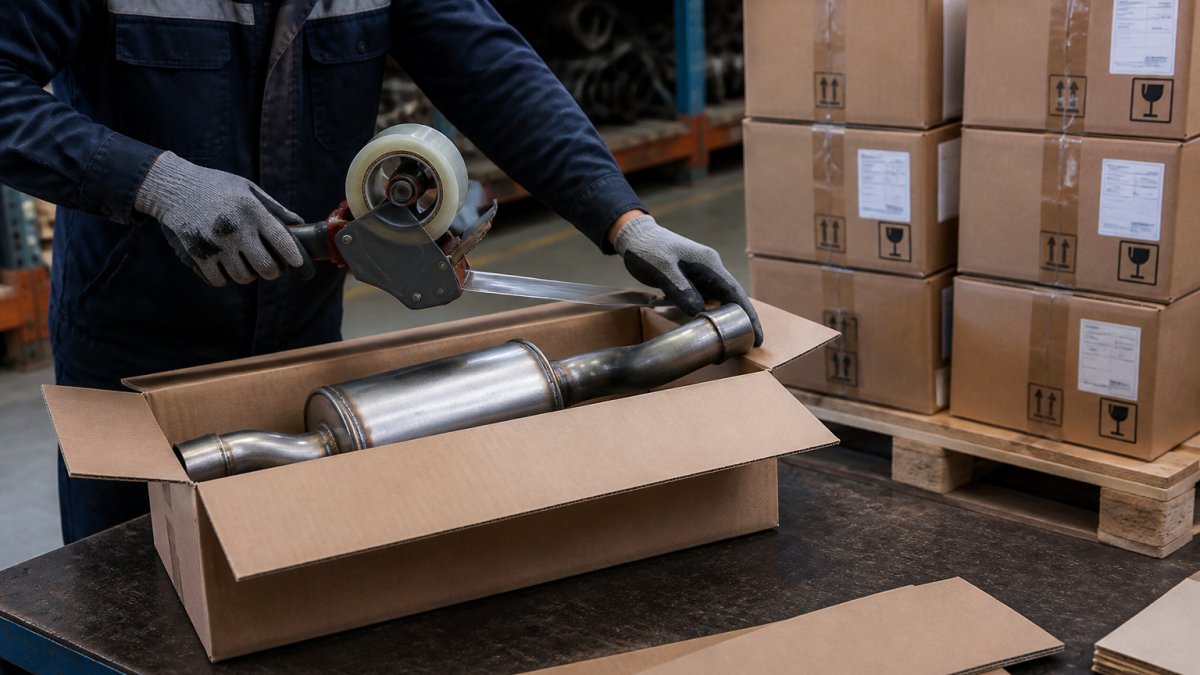
General Packaging for Heavy and Fragile Parts
Fragile and heavy items need bracing, double-wall cartons, and clear orientation labels. A well-packed shipment survives the last mile; a poorly packed one arrives bent. For body panels and glass, use edge protection and a rigid outer carton. For heavy components, secure the part to a pallet base so it cannot shift, and mark the weight and "this side up" orientation clearly.
Item-Specific Rules for Regulated Parts
The dangerous-goods category is broad, but the rules that matter to a buyer are narrow and item-specific:
- Batteries, Lead-acid and lithium batteries are regulated for transport. Carriers require them to be declared, packaged to prevent short circuits, and in many cases shipped by ground rather than air. A battery shipped without the correct declaration can be refused at the depot.
- Fluids and aerosols, Oils, brake fluid, and aerosol products are classified as dangerous goods. They must be in original, leak-proof packaging and declared at booking. Many carriers will not accept them by air.
- Airbags and pyrotechnic components, Airbag modules and seat-belt pretensioners contain pyrotechnic charges and are treated as dangerous goods. They typically require special declaration and carrier acceptance before pickup, and some carriers decline them entirely.
Labelling and Documentation
Every regulated shipment needs the correct marks and documentation: the dangerous-goods declaration, the UN number where applicable, and the orientation and handling labels the carrier requires. Missing paperwork is the most common reason a regulated shipment is held at the depot. Keep copies of the declaration with your order records in case a claim is needed.
What This Means for Your Order
Before ordering a regulated part, confirm three things: whether the item is classified as dangerous goods, which carrier service will accept it, and whether the seller provides the required declaration. If any answer is unclear, ask support in writing. The same discipline that prevents a wrong-part return also prevents a refused shipment.
Tracking, Delivery Exceptions, and Damaged Shipments
Tracking is the carrier's record of a shipment's progress, and delivery exceptions are the events that interrupt it: missed scans, address issues, weather holds, or failed delivery attempts. Check tracking the day it ships, not the day it is late.
If a shipment arrives damaged, photograph the box before opening, keep all packaging, and report it within the carrier's claim window. Do not discard the carton; the claim depends on it.
Returns and Exchanges When a Part Does Not Fit
Returns for incorrect or incompatible parts hinge on condition and documentation. Most policies require the part to be unused, in original packaging, and reported within a set window. Return shipping cost often falls on the buyer unless the error was the seller's.
Before you return anything, confirm the part number against your VIN and photograph the label. A fitment error caught before installation is a simple exchange; one caught after is a dispute.
Ordering Your Next Part With No Surprise Fees
The way to avoid surprise fees is to demand the landed cost before you pay. Ask for the delivered total, confirm the shipping origin, and check the fitment against your VIN. Readers comparing retailers can also read ToofastAutoparts vs Autopartsway for performance parts.
At My Parts Guy MPG Auto, we ship from within the country with no duties or brokerage fees, monitor competitor pricing to keep our numbers competitive, and put decades of automotive knowledge behind every fitment question. For a companion read on purchasing, see our guide to buying performance parts without hidden fees.
Frequently Asked Questions
How can I estimate auto parts shipping costs before checkout?
Enter your full postal code at checkout rather than just the province, because remote and residential addresses can carry surcharges that a province-level estimate misses. Check the weight and dimensions of oversized items like exhaust systems or bumpers, since these often ship by freight rather than parcel. Confirm whether the free-shipping threshold applies to your cart total before or after discounts, and ask the retailer directly if any brokerage or handling fees apply. A quote in writing beats a checkout estimate every time.
Are there duties or tariffs on auto parts coming into Canada?
Parts manufactured in Canada, the US, or Mexico can qualify for preferential tariff treatment under the Canada-United States-Mexico Agreement, but the importer still pays federal and provincial sales taxes at the border. Parts from other countries may attract duty under Canada's Customs Tariff, plus GST or HST. Brokerage fees are separate from duty and are charged by the carrier for clearing the shipment. Always confirm who pays these fees before ordering from a seller outside Canada.
How long does auto parts delivery take?
Parcel shipments between major urban centres typically arrive within a few business days, while rural, remote, and northern addresses add transit time because carriers consolidate routes. Freight shipments for oversized items like exhaust kits or body panels usually take longer and require a scheduled delivery window or a terminal pickup. Weather, customs clearance on cross-border orders, and stock availability at the warehouse all affect the final date. Ask for a tracking number and a delivery estimate in writing.
What should I check before ordering auto parts online?
Verify fitment using your VIN or the part number from your vehicle's existing component, not just the make and model year. Confirm the seller's return policy covers incorrect-fit returns and who pays return shipping. Check whether the listed price includes duties, taxes, and brokerage, and whether free shipping applies to your postal code. Finally, confirm the part is legal for road use in your province, particularly for exhaust and lighting upgrades, before you complete the purchase.
What happens if an auto part arrives damaged or does not fit?
Photograph the packaging and the part before installation and report the damage to the retailer within the stated claim window, usually a few days of delivery. For fitment issues, have your VIN and the part number ready so the seller can confirm whether the wrong item was shipped or the listing was incorrect. Keep the original packaging for the return. Retailers that ship from within Canada typically handle these claims faster because there is no cross-border paperwork to resolve.
Shipping surprises come from three places: freight surcharges, cross-border brokerage, and wrong-part returns. My Parts Guy MPG Auto removes the first two by shipping domestically with no duties or brokerage fees, and reduces the third with fitment support backed by decades of automotive knowledge and personalized customer service. Get started with My Parts Guy MPG Auto and order your next part at the price you were quoted.

