
How to Identify Fake Car Parts: 7-Step Verification
Table of Contents
- Why Counterfeit Car Parts Are a Growing Risk in Canada
- 7 Warning Signs of Fake Car Parts
- Step-by-Step: How to Verify OEM Parts Before You Install
- Counterfeit Car Parts Safety Risks You Can't Ignore
- Buying Genuine Auto Parts Online: A Seller Verification Checklist
- Counterfeit vs. Aftermarket vs. Refurbished vs. Used: What's the Difference?
- What to Do If You Suspect You Bought a Fake Part
- Frequently Asked Questions
Last Updated: October 8, 2026
Why Counterfeit Car Parts Are a Growing Risk in Canada
Counterfeit car parts are fake components made to look like genuine manufacturer products, often sold through online marketplaces and informal sellers at far lower prices.
The danger comes after installation: a fake brake pad or suspension arm can fail without warning, putting you, your passengers, and everyone around you at risk.
Below, we'll show you how to spot a fake before it goes on your car.
7 Warning Signs of Fake Car Parts
The fastest way to spot a fake is to look for several small problems at once. One odd detail might mean nothing. Three or four together almost always mean trouble.
Watch for these signs of fake car parts:
- A price far below every other seller
- Blurry or crooked printing on the box
- A seller who won't confirm they're an authorized dealer
If two or more show up, walk away. There are plenty of legitimate sellers out there.
Packaging and Label Red Flags
Genuine manufacturer packaging is crisp, consistent, and well made. Counterfeit packaging usually isn't.
Check the label for spelling errors, fuzzy logos, and off colors. Real boxes also carry a batch or lot number, a country of origin, and clear manufacturer contact details.
Run your finger along the seams. Genuine boxes are glued or sealed evenly. Fakes often look rushed.
Price and Seller Red Flags
An unusually low price is the single biggest warning sign. Genuine parts have real costs behind them, so a deal that looks too good usually is.
Ask the seller directly: "Are you an authorized dealer for this brand?" A real dealer answers without hesitation; a fake seller dodges, changes the subject, or stops replying.
Also check where the seller operates: a storefront with no address, return policy, or phone number is a hard pass.
Step-by-Step: How to Verify OEM Parts Before You Install
Verifying OEM parts takes about ten minutes and a phone. OEM parts are made by the original vehicle manufacturer or an approved supplier.
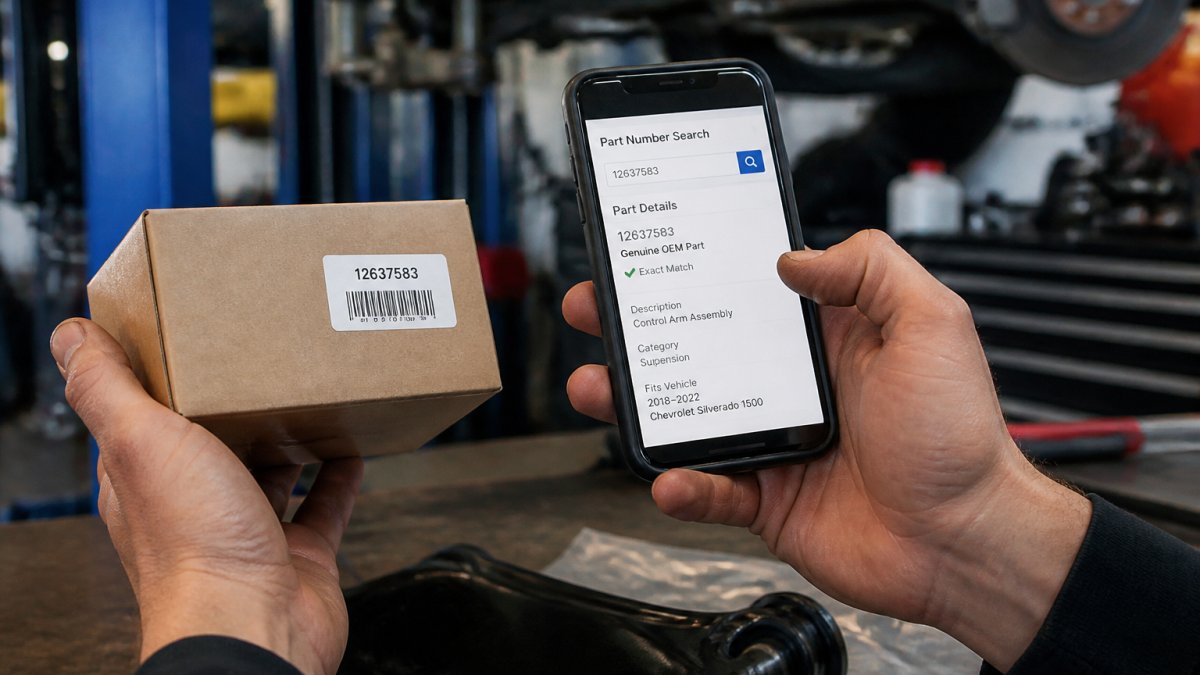
Follow these steps before you install anything:
- Find the part number on the box and on the part itself
- Check that both numbers match each other
- Search the number on the manufacturer's official site
- Scan the barcode or QR code if one is present
- Compare the part against official photos and specs
- Confirm the seller is listed as an authorized partner
- Keep your receipt and warranty paperwork
If any step fails, stop. Don't install the part until you've confirmed it's real.
Check Part Numbers, Serial Numbers, and Barcodes
Every genuine part carries a part number, and most carry a serial number too; both should match across the box, label, and part.
A barcode or QR code should scan and lead to real product info; if it won't scan or the number comes back unknown, treat that as a red flag.
Here's how the identifiers break down:
| Identifier | Where to Find It | What to Check |
|---|---|---|
| Part number | Box, label, part | Matches across all three |
| Serial number | Part, sometimes label | Unique, not repeated |
| Barcode / QR code | Packaging | Scans to real product info |
| Batch or lot number | Label | Present and legible |
Compare Markings and Specifications Against Manufacturer Records
Lay the part next to official manufacturer photos and compare logo placement, font, and finish.
Genuine parts have clean casting marks and even coatings; fakes often show rough edges, uneven paint, or a slightly wrong-sized logo.
Check weight and materials too: a brake rotor that feels too light is a serious concern. Cross-check specs like dimensions and thread sizes against manufacturer records.
Counterfeit Car Parts Safety Risks You Can't Ignore
Counterfeit car parts safety risks are real and show up fast: brakes, steering, and suspension parts carry your life every time you drive.
A fake brake pad can wear out in weeks. A counterfeit airbag may not deploy at all.
These aren't small inconveniences. They're failures that happen at the worst possible moment, usually at speed.
Safety-critical parts deserve the most scrutiny:
- Brakes and brake lines
- Airbags and seatbelts
- Steering components
For these, buy only from a verified seller. The savings aren't worth the risk.
Buying Genuine Auto Parts Online: A Seller Verification Checklist
Buying genuine auto parts online comes down to verifying the seller before you pay. Use this checklist every time:
- Seller lists a real business name and address
- Seller confirms authorized dealer status in writing
- Return policy and warranty terms are clear
If a seller fails two or more of these, look elsewhere.
Authorized Dealers vs. Online Marketplaces
Authorized dealers buy directly from the manufacturer or an approved distributor. They can confirm authenticity and honor warranties.
Online marketplaces host thousands of independent sellers. Some are legitimate. Many are not, and the platform rarely checks every listing.
Marketplaces aren't automatically bad. But you carry more of the verification work yourself. When in doubt, choose a seller who can prove where the part came from.
Counterfeit vs. Aftermarket vs. Refurbished vs. Used: What's the Difference?
Most guides blur these four categories together, which is why honest sellers get punished and counterfeiters keep slipping through. They are not the same thing, and the law treats them differently.
- Counterfeit: An unauthorized copy sold as a genuine branded part. The seller misrepresents the brand, the origin, or both. This is the category that is illegal to sell and dangerous to install.
- Aftermarket: A new part made by a company other than the original vehicle manufacturer. It is legal, it is labeled as its own brand, and quality ranges from excellent to poor depending on the maker.
- Refurbished: A used part that has been disassembled, inspected, and restored to working condition, usually by a specialist. It should come with documentation of what was replaced.
Why the Label, Not the Origin, Is the Real Test
The dividing line is not "OEM versus not OEM." It is whether the seller tells you the truth about what you are buying.
A counterfeit claims to be a branded genuine part; an aftermarket part claims to be an aftermarket part. One lies, the other does not, and that distinction separates a legitimate purchase from a fraudulent one and determines whether you have a remedy if something goes wrong.
A Quick Decision Framework
Ask these questions in order:
- Does the seller name the actual manufacturer of the part? If the answer is vague ("OEM quality," "same factory"), treat it as a warning sign.
- Is the brand on the box the brand of the company that made the part? If a box carries a major brand name but the seller cannot confirm authorized dealer status, you are likely looking at a counterfeit.
- Is the part described as new, refurbished, or used? A legitimate listing states this plainly. A counterfeit listing usually says "new genuine" and nothing else.
- Does the price match the category? A refurbished alternator at 40 percent of new is plausible. A "new genuine" alternator at 40 percent of new is not.
- Will the seller put the category in writing on the receipt? Honest sellers will. Counterfeiters will not.
Where Each Category Makes Sense
- Aftermarket is often the right call for wear items, accessories, and older vehicles where OEM pricing no longer makes sense. Reputable aftermarket brands publish their own part numbers and warranty terms.
- Refurbished works well for components with a strong rebuild market, such as alternators, starters, and some brake calipers, provided the rebuilder is named and the warranty is in writing.
- Used is reasonable for body panels, interior trim, and non-safety components where fitment matters more than wear. It is a poor choice for brakes, airbags, steering, and suspension.
What to Do If You Suspect You Bought a Fake Part
Here is the full sequence, in the order that protects you best.
Step 1: Stop the Install and Isolate the Part
Do not install the part. If it is already on the vehicle, have a qualified technician inspect it before you drive further. Safety-critical components such as brakes, airbags, steering, and suspension should be treated as unsafe until proven otherwise. Put the part, the packaging, and any inserts in a bag and keep them together. Do not throw anything away, including the shipping box.
Step 2: Build the Evidence File
Before you contact anyone, capture everything:
- Photos of the part from multiple angles, including any casting marks, logos, and part numbers
- Photos of the packaging, label, batch or lot number, and barcode or QR code
- A screenshot of the product listing as it appeared when you bought it, including the price and the seller's claims
Save these to a folder you can attach to emails. If the listing later changes or disappears, your screenshot is the only record of what was promised.
Step 3: Contact the Seller in Writing
Send a written request for a refund. State the facts plainly: what you bought, what you paid, why you believe the part is counterfeit, and what you want. Attach your photos.
If the seller offers a replacement instead of a refund, decline unless you can verify the replacement independently. A seller who shipped one counterfeit part is not a reliable source for a second one.
Step 4: Escalate to the Platform
If the seller does not respond or refuses a refund, open a dispute with the platform or payment provider. Most major marketplaces and card issuers have a defined filing window, and counterfeit goods are typically covered under buyer protection policies. Reference the evidence file and the seller's refusal in writing.
Step 5: Report to the Manufacturer
Most major automotive brands operate a brand protection or anti-counterfeiting team. Report the seller, the listing, and the part number. Manufacturers track these reports and can confirm whether a part number is genuine, whether a seller is authorized, and whether the packaging matches their current design.
Step 6: Report to the Right Authority
In Canada, the Competition Bureau handles deceptive marketing practices, including misrepresentation of goods, and you can file a complaint through the Bureau's online form. If the part was sold across provincial borders or through a commercial channel, the Bureau is the appropriate federal contact. For safety-related concerns, Transport Canada maintains vehicle safety recall and defect information; if a counterfeit part is linked to a safety defect, that is worth checking and reporting.
Step 7: Protect Yourself Going Forward
If the part caused damage to your vehicle, document the repair estimate and keep it with your evidence file.
For guidance on your rights as a buyer, see the Competition Bureau Canada guidance on deceptive marketing. You can also review Transport Canada's vehicle safety recall and defect information to check whether a part or vehicle has a known safety issue.
Frequently Asked Questions
How can you tell if a car part is fake?
Check the packaging for spelling errors, poor print quality, or missing brand logos. Look for a serial number or part number that can be verified against manufacturer records. Fake car parts often have unusually low prices and come from sellers who are not authorized dealers. If the part feels lightweight or has rough edges, it may be counterfeit.
What are the signs of counterfeit auto parts?
Common signs include packaging that looks different from the manufacturer's original, missing or mismatched part numbers, and logos that are blurry or misspelled. The part itself may have poor fit and finish, use inferior materials, or lack safety certifications. Sellers may avoid providing a purchase receipt or warranty. Trust your instincts if a deal seems too good.
Are fake car parts dangerous to use?
Yes. Counterfeit car parts can fail suddenly, leading to brake failure, engine damage, or electrical fires. They often use substandard materials that don't meet safety standards, increasing the risk of accidents. Using fake parts may lead to costly repairs. Always prioritize safety by verifying authenticity before installation.
What should I do if I bought a fake car part?
Stop using the part immediately and do not install it. Contact the seller to request a refund. If you installed it, have a certified mechanic inspect your vehicle for damage. Keep the receipt and packaging as evidence. In the future, buy from authorized dealers or reputable online sellers.