
7 Safe Engine Tuning Steps for Daily Drivers
Last Updated: October 28, 2026
Quick Summary
Safe engine tuning for daily drivers means running a pre-tune health check first, then choosing a conservative Stage 1 calibration from a tuner who supports your exact engine code. A tune amplifies existing faults, so even compression, clean fluids, and no stored fault codes are the minimum bar before you flash.
- Scan every module for stored misfire, lean-condition, or boost-leak codes before tuning.
- Compression should be even across all cylinders; a single low cylinder is a red flag.
- A safe Stage 1 tune adjusts only air-fuel mixture, ignition timing, and boost pressure.
- Run premium fuel at or above the tuner's specified octane every tank, not just on track days.
- Cut oil change intervals roughly in half after a tune and log pulls to confirm safe behavior.
Table of Contents
- Start With a Pre-Tune Health Check
- Choose the Right Daily Driver ECU Tune for Your Goals
- What a Safe Stage 1 Tune Actually Changes
- Fuel Quality, Cooling, and Thermal Limits
- Your Engine Tuning Maintenance Checklist
- Verify the Tune and Monitor Results With Data Logs
- Emissions, Inspection, and Warranty Realities
- Pick Your Tune and Parts With MPG Auto
- Frequently Asked Questions
Start With a Pre-Tune Health Check
Safe engine tuning for daily drivers starts long before you flash a file. A tune amplifies whatever condition your engine is already in: good compression stays good, and a worn ring gets worse.
Engine tuning is the process of adjusting an engine's control software to change how it delivers power, usually by altering fuel, ignition, and boost targets.
Run the checks in this order. Stop and repair before moving to the next step if anything fails.
- Maintenance history: confirm the oil, plugs, and filters have been changed on schedule. A car with unknown service history is a car you inspect harder, not one you skip.
- Fault codes: scan every module, not just the engine computer. Stored misfire, lean-condition, or boost-leak codes will get worse under a tune. Clear them only after the underlying fault is repaired.
- Compression test: confirms ring and valve sealing on every cylinder. Even across all cylinders is the pass mark; a single low cylinder is a red flag.
- Leak-down test: pinpoints where pressure escapes, intake, exhaust, or rings, so you know whether the fix is a valve job or a rebuild.
- Ignition components: check plug gap and heat range, coil condition, and any sign of misfire under load. Replace worn plugs before the flash, not after.
- Fluids: milky oil points to a head gasket issue, dark burnt transmission fluid suggests the gearbox is already stressed, and low or discolored coolant hints at a cooling problem that heat-soak will expose.
- Intake path: a clogged air filter chokes intake airflow before you even start, and loose clamps or cracked hoses become boost leaks once pressure rises.
Compression, Leak-Down, and Fluid Inspection
Compression should be even across all cylinders. A single low cylinder is a red flag. Leak-down testing then tells you why: air escaping past the rings, the intake valve, or the exhaust valve.
Fluids tell the rest of the story. Milky oil points to a head gasket issue. Dark, burnt transmission fluid suggests the gearbox is already stressed. Fix these before adding power, not after.
Scanning for Stored Fault Codes Before You Flash
Plug in a scan tool and read every module, not just the engine computer. Stored codes for a misfire, a lean condition, or a boost leak will get worse under a tune.
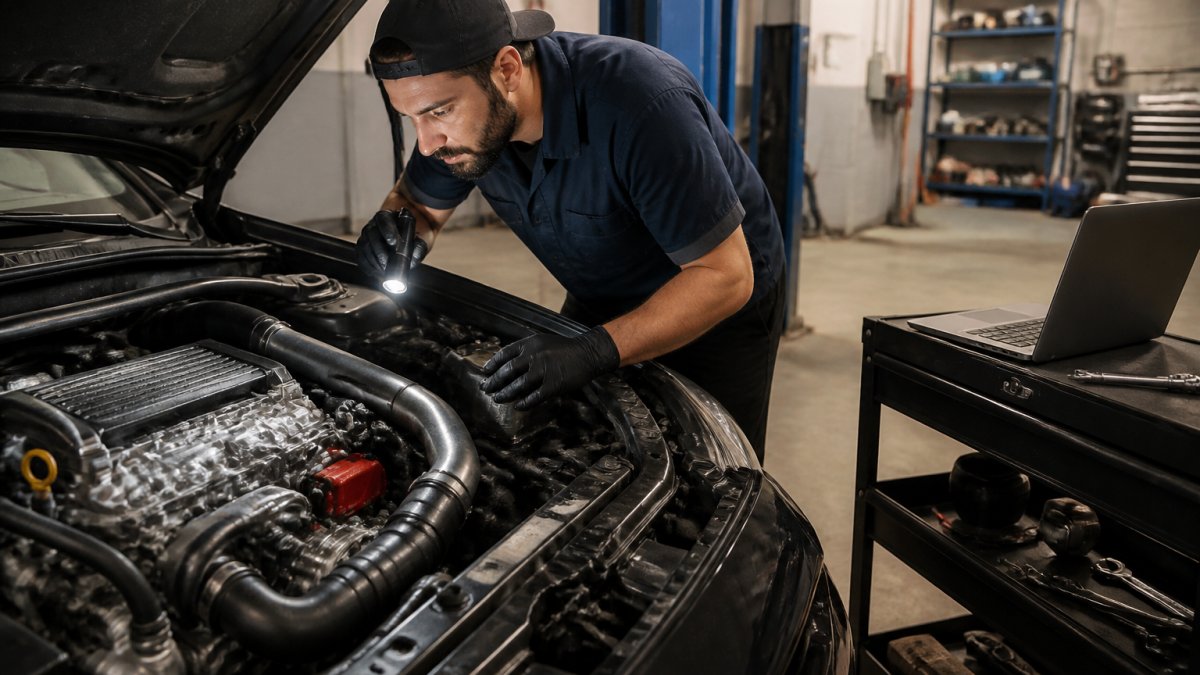
Run these checks in order and repair any failure before moving to the next step.
| Step | What to do | Pass mark |
|---|---|---|
| Maintenance history | Confirm oil, plugs, and filters changed on schedule | Unknown history means inspect harder |
| Fault codes | Scan every module, not just the engine computer | No stored misfire, lean, or boost-leak codes |
| Compression test | Confirm ring and valve sealing on every cylinder | Even across all cylinders |
| Leak-down test | Pinpoint where pressure escapes | Identifies rings, intake, or exhaust valve |
| Ignition components | Check plug gap, heat range, coil condition | Replace worn plugs before the flash |
| Fluids | Check oil, transmission fluid, coolant | No milky oil, burnt fluid, or low coolant |
| Intake path | Inspect filter, clamps, and hoses | Clean filter, no loose clamps or cracks |
Choose the Right Daily Driver ECU Tune for Your Goals
The best daily driver ECU tune is a conservative Stage 1 calibration from a tuner who supports your exact engine code.
ECU remapping and ECU reflash both rewrite the factory calibration. A piggyback tuner sits between the sensors and the ECU and alters signals instead.
Before you buy, ask three questions:
- Does the tuner list your exact engine and transmission code?
- Do they offer data-log review after the flash?
- Is there a clear path back to stock?
That third point matters more than most buyers realize. A tuner who cannot return your car to stock cleanly is a tuner to skip.
What a Safe Stage 1 Tune Actually Changes
A safe Stage 1 tune adjusts three things: air-fuel mixture, ignition timing, and boost pressure. Nothing else. It does not touch hardware, and it stays inside the safety margin the factory left on the table.
Air-Fuel Mixture, Ignition Timing, and Boost Pressure
- Air-fuel mixture: richer under load to control cylinder temperature
- Ignition timing: advanced for more torque, but pulled back when knock is detected
- Boost pressure: raised modestly, staying within turbo and intercooler limits
The goal is power delivery you can use every day, not a dyno queen. A good Stage 1 tune improves throttle response and mid-range torque without making the car twitchy in traffic.
Knock is the limiting factor. If the tune pushes timing too far on lower-grade fuel, the ECU pulls timing to protect the engine, and you lose the gains you paid for.
Fuel Quality, Cooling, and Thermal Limits
Premium fuel is not optional on a tuned turbocharged engine. Higher octane resists knock, which lets the calibration run its intended timing and boost targets.
Most tuners specify a minimum octane for a given file, and the safe habit is to run at or above that number every tank, not just on track days. Fuel quality matters as much as octane: a tank of poor-quality fuel can trigger knock retard even at the correct rating.
Real-World Fuel and Operating Costs
Budget for the tune as an ongoing cost, not a one-time purchase. The main line items are:
- Fuel: a tuned engine typically burns more under load, and premium costs more per liter than regular. Estimate your annual fuel spend at the premium grade before you commit.
- Installation and file: the flash or bench service, plus any data-log review your tuner includes.
- Maintenance: shorter oil intervals and more frequent plug checks add up over a year.
A common pattern is that the tune itself is the smallest cost; fuel and maintenance are the recurring ones. Price the whole package in Canadian dollars before you decide.
Cooling System and Thermal Limits
Cooling system health decides how much power you can safely hold. Heat soak in traffic raises engine temperature and intake temps, and the ECU pulls power to protect itself. Check the coolant, the thermostat, and the intercooler condition before tuning.
Watch these limits rather than chasing a peak number:
- Intake air temperature: should recover quickly after a pull; a rising trend in traffic means the intercooler is heat-soaked.
- Coolant temperature: should stay in its normal band under sustained load, not climb toward the warning zone.
- Oil temperature: sustained high oil temps thin the oil and accelerate wear, which is why shorter intervals matter.
Watch out: a tune that ignores thermal limits will feel strong on a cool morning and flat after twenty minutes of stop-and-go. That is heat, not a bad file.
Your Engine Tuning Maintenance Checklist
Shorter oil change intervals are the single most important habit after a tune. Extra boost means more heat and more load on the oil. Many tuners recommend cutting the interval roughly in half.
Run this checklist on a set schedule:
- Change oil and filter more often than the factory interval
- Check spark plugs every few thousand kilometers, replace if fouled
- Inspect intake airflow path for leaks and loose clamps
If you are building a full plan, our list of essential maintenance parts for performance cars covers the components worth keeping on hand.
Verify the Tune and Monitor Results With Data Logs
Data logs are how you prove the tune is safe, not just fast. A log records boost pressure, air-fuel ratio, ignition timing, knock retard, and intake temperature under a full pull.
Look for these signals:
- Knock retard: should stay near zero under load
- Air-fuel ratio: should stay rich and stable at wide-open throttle
- Boost pressure: should hit target without spiking past it
If timing is being pulled hard or the mixture leans out, stop and talk to your tuner. Do not keep driving on a log that looks wrong.
Emissions, Inspection, and Warranty Realities
A tune can affect emissions compliance and your factory warranty, and you should know where you stand before you flash. In Canada, emissions inspection rules vary by province, so check your local requirements rather than assuming.
On warranty, a dealer can decline a claim if they can show the modification caused the failure. Our guide on how to tune a BMW B58 without voiding warranty walks through the practical side of that conversation.
Pick Your Tune and Parts With MPG Auto
Choosing the right tune and supporting parts comes down to fitment and support, not just the file itself.
Before you buy, check part compatibility online against your exact model and engine code. Then buy performance parts without hidden fees, with pricing monitored against major retailers and shipping across Canada free of duties or brokerage.
As one customer put it, "John was very professional and very helpful."
Frequently Asked Questions
Can you tune a daily driver without reducing reliability?
Yes, if the tune stays within conservative limits and the engine is healthy beforehand. A safe Stage 1 tune on a turbocharged engine typically adds modest boost pressure and adjusts ignition timing and air-fuel mixture without pushing hardware past its design margins. Reliability drops when tuners chase maximum horsepower on stock internals, skip cooling upgrades, or ignore maintenance. Keep power gains moderate, run premium fuel as specified, and log the engine regularly to catch knock or high engine temperature early.
What should you check before tuning a daily driver?
Run a compression or leak-down test, scan for stored fault codes, and inspect spark plugs, coils, intake airflow components, and the cooling system. Confirm the transmission and clutch can handle added torque, and check tire and brake condition since more power changes how the car behaves. Fresh oil and filters matter too. Any pre-existing misfire or boost leak will get worse after an ECU reflash, so fix problems first rather than tuning around them.
Does an ECU tune affect fuel economy during everyday driving?
It can go either way. Many daily driver ECU tunes improve fuel efficiency slightly during steady cruising because ignition timing and air-fuel mixture are optimized for part-throttle conditions. However, the extra horsepower and torque encourage harder acceleration, which raises consumption. Real-world operating costs also rise if the tune requires premium fuel. Track your fuel economy over a few tanks before and after tuning to see the actual difference in your driving.
What maintenance should you do after tuning a daily driver?
Shorten oil change intervals, typically to 8,000-10,000 km depending on driving conditions, and use the fuel grade your calibration calls for. Check spark plugs more often, inspect intake and boost plumbing for leaks, and watch engine temperature and knock readings with a data logger. Follow an engine tuning maintenance checklist that includes transmission fluid, coolant condition, and brake and clutch wear. Catching small issues early is what keeps a tuned daily driver reliable long term.
Tuning a daily driver is a balance between power and reliability, and the margin for error shrinks the moment you skip the health check or ignore a bad data log. My Parts Guy MPG Auto carries the maintenance parts, plugs, and supporting hardware that keep a conservative tune safe for years, backed by decades of automotive knowledge and personalized support. Get started with My Parts Guy MPG Auto and build a tune you can trust on the commute and the back road alike.

