
Essential Maintenance Parts for Performance Cars
Table of Contents
- Essential Maintenance Parts for Performance Cars: What Actually Matters
- Your Performance Car Maintenance Checklist
- Performance Car Brake Pads and Rotors: When to Replace
- Performance Car Oil and Fluids: Beyond the Oil Change
- Building a Performance Car Maintenance Schedule
- OEM-Quality vs. Performance Upgrades: How to Choose
- Conclusion: Prioritize, Inspect, Repeat
- Frequently Asked Questions
Last Updated: October 12, 2026
Essential Maintenance Parts for Performance Cars: What Actually Matters
The parts that keep a performance car alive are not the glamorous ones. They are the belts, fluids, filters, pads, and rotors that quietly absorb heat and stress every time you drive hard. At My Parts Guy MPG Auto, we leverage decades of automotive knowledge to help enthusiasts sort the parts that genuinely matter from the ones that just look good on a build sheet. This guide covers the essential maintenance parts for performance cars, when to replace each one, and how to choose between OEM-quality replacements and upgrades.
A performance car is a vehicle engineered for higher power output, sharper handling, and harder use than a standard model, which means its wear parts work under greater load and fail sooner. That single fact should shape every maintenance decision you make.
Below, we break down a practical checklist, the parts that wear fastest, and how to build a schedule that fits how you actually drive.
Your Performance Car Maintenance Checklist
A performance car maintenance checklist is a recurring set of inspections and replacements organized by how often they are needed, from a weekly walkaround to annual service items. The goal is catching wear before it becomes a failure.
The 10-Minute Weekly Walkaround
Spend ten minutes once a week on the basics. Check tire pressures against the door-jamb spec, look for nails or sidewall damage, and confirm all lights work. Pop the hood and check the engine oil level on the dipstick, plus coolant level in the reservoir. Look under the car for fresh drips.
This walkaround catches the small problems that turn into expensive ones. A slow coolant weep found early is a hose clamp. Found late, it is a warped head.
Transport Canada vehicle safety and inspection guidance
Fluids and Filters: The Lifeline of Your Engine
The engine oil, oil filter, air filter, and coolant are the parts that decide how long your engine lasts. We group them first because everything else depends on them.
- Engine oil: The single most important fluid. It lubricates, cools, and carries contaminants to the filter.
- Oil filter: Traps metal particles and sludge. A clogged filter bypasses dirty oil straight back into the engine.
- Air filter: Feeds clean air to the intake. A restricted filter costs power and fuel economy.
- Coolant: Manages heat in the cooling system. Old coolant loses its corrosion protection.
Performance Car Brake Pads and Rotors: When to Replace
Performance car brake pads and rotors are the parts you should inspect most often, because braking performance is a safety system first and a performance system second. Pads wear down and rotors develop grooves, cracks, or thickness loss.
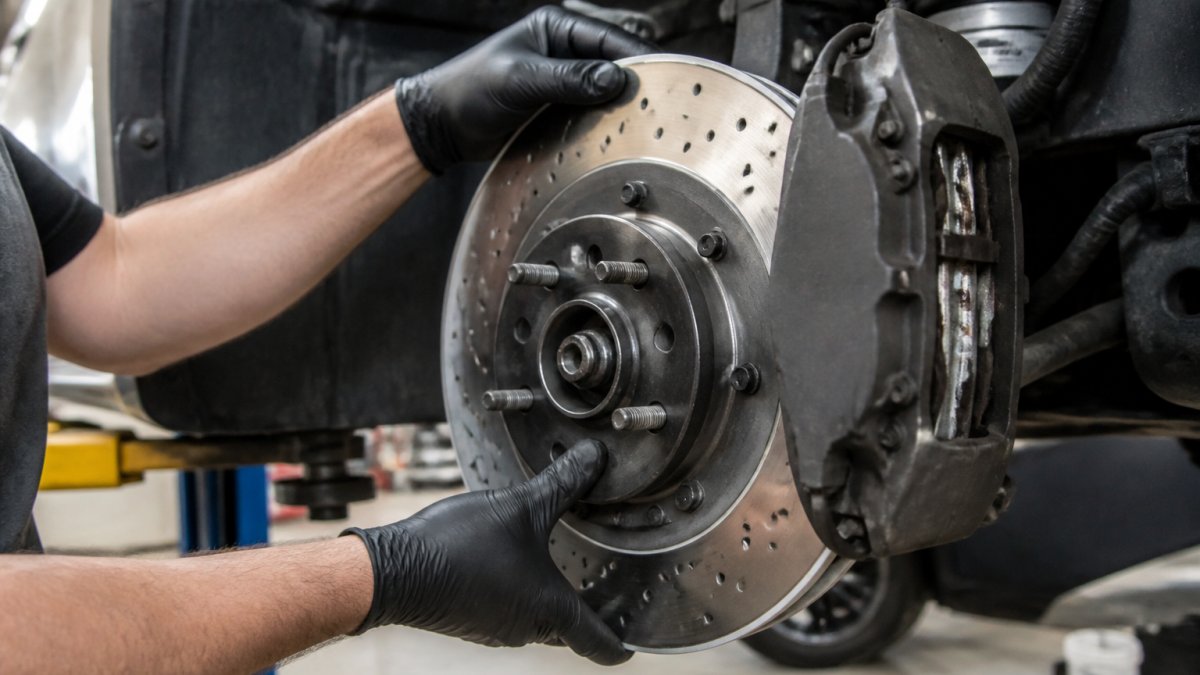
Replace pads when friction material drops to roughly 3 mm, or sooner if you track the car. Replace rotors when they fall below the minimum thickness stamped on the hat, when they show cracks around drilled holes, or when they pulse under braking.
For BMW owners, a kit like the Brembo OE front disc brake kit for 230i and 320i models pairs high-carbon cast iron rotors with ceramic pads that cut noise and dust. Rotor choice matters: drilled rotors cool faster at high temperatures, while OE-style rotors suit daily driving.

| Symptom | Likely Cause | Action |
|---|---|---|
| Squeal at low speed | Wear indicator contacting rotor | Replace pads soon |
| Pulsing pedal | Rotor thickness variation | Replace rotors |
| Long pedal travel | Fluid degradation or air | Bleed and inspect fluid |
| Cracks at drilled holes | Thermal stress | Replace rotors immediately |
Performance Car Oil and Fluids: Beyond the Oil Change
Performance car oil and fluids extend well beyond the engine sump. Transmission fluid, brake fluid, coolant, and differential fluid all degrade with heat, and each one protects a system that is expensive to replace.
Brake fluid absorbs moisture over time, which lowers its boiling point. On a track car, that means fade or a soft pedal when you need stopping power most. Coolant loses corrosion inhibitors and can turn acidic, eating water pump seals and radiator cores from the inside.

We recommend a simple rule: any fluid that has a service interval in your manual gets changed on schedule, and any fluid exposed to repeated track heat gets changed early.
IAG Performance IAG 105K Service Package w/ AISIN Water Pump Fits 2004-07 →
Building a Performance Car Maintenance Schedule
A performance car maintenance schedule is a written plan that maps each part to a mileage or time interval based on how the car is used. The same car driven gently and driven on track need different schedules. Engineers often design these high-output platforms with unique tolerances that necessitate specialized Japanese car maintenance to preserve their mechanical integrity under extreme conditions.
Street, Track, and Mixed-Use Intervals
Match your intervals to your use case, not just the odometer. A street car and a track car with identical mileage can have very different wear.
| Use Case | Oil Change | Brake Fluid | Pads/Rotors | Coolant |
|---|---|---|---|---|
| Street only | Per manual, shorter if tuned | Every 2 years | Inspect yearly | Per manual |
| Mixed use | Shorter interval, check after events | Yearly | Inspect each event | Per manual, check yearly |
| Track focused | After every few events | Before each event | Inspect every event | Check each season |
For Subaru owners, the IAG 105K service package with AISIN water pump for 2008-21 STI bundles the timing belt, tensioner, idlers, thermostat, seals, and water pump into one service. Doing timing and water pump work together saves labor, because the same teardown reaches both.
OEM-Quality vs. Performance Upgrades: How to Choose
OEM-quality replacement parts restore factory reliability, while performance upgrades change how the car behaves. The right choice depends on your goal, not on which part costs more. Most guides stop there. The useful part is a decision framework and a fitment checklist, because the wrong upgrade on a healthy car is money wasted, and the wrong replacement on a modified car is a weak link waiting to fail.
A Simple Decision Framework
Ask three questions before you buy:
- Is this part a wear item or a capability item? Wear items (seals, timing components, water pumps, standard brake hardware, filters, fluids) should be OEM-quality unless you have a specific reason to change them. Capability items (cooling, intercooling, brakes for track heat, suspension for grip) are where upgrades earn their place.
- What problem does the upgrade solve? If you cannot name the problem in one sentence, you are buying a part, not a solution. A bigger intercooler does nothing for a car with a failing water pump.
- What does the upgrade stress next? More power stresses the clutch, cooling system, and brakes. More grip stresses suspension bushings and tires. Upgrading one part without supporting the next is how builds become unreliable.
Prioritization When Funds Are Limited
If you can only spend on one thing at a time, spend in this order:
- Safety and reliability first. Brakes, tires, fluids, cooling, and timing components. A car that cannot stop or cool itself is not a performance car.
- Wear items that are already due. Replace what is worn before adding capability.
- Capability upgrades that address a real limitation. Track heat, boost control, or grip, in that order of impact for most drivers.
- Cosmetic and convenience last. These do not make the car faster or more reliable.
Fitment and Compatibility Checklist
Fitment is where most online purchases go wrong. Before ordering, confirm:
- Year, make, model, and trim. Trims within the same model year can use different brake sizes, hub patterns, and cooling layouts.
- Engine and drivetrain code. A part listed for the platform may not fit your specific engine or transmission.
- Specifications and materials. Rotor diameter and thickness, pad compound, hose material and rated temperature, and fastener grade all matter. A part that fits physically can still be wrong for the application.
- Software and calibration. Some upgrades, particularly intake and exhaust changes, require a tune to run correctly. Without it, you may lose power or trigger a check-engine light.
- Warranty and emissions. Modifications can affect warranty coverage and may not be legal for road use in all provinces. Check before you buy.
Conclusion: Prioritize, Inspect, Repeat
The challenge with performance car ownership is that the parts that matter most are the ones nobody photographs. Prioritize fluids and filters first, inspect brakes and tires on a fixed schedule, and replace wear parts by condition, not by hope.
My Parts Guy MPG Auto stocks the maintenance components enthusiasts actually need, from timing service packages to Brembo brake kits, with decades of automotive knowledge behind every recommendation, competitive pricing, and fast shipping with no duties or brokerage fees. Get started with My Parts Guy MPG Auto and keep your car performing the way it was built to.

Frequently Asked Questions
Do performance cars need different maintenance parts than regular cars?
Yes, performance cars often use higher-specification parts designed to handle more heat, stress, and higher speeds. For example, brake pads and rotors on a performance car may be drilled or slotted for better cooling, and fluids like engine oil often need higher temperature resistance. However, many OEM-quality parts are engineered to meet or exceed original standards, so you don't always need a full race upgrade for daily driving.
How often should performance car brake pads and rotors be replaced?
It depends on driving style. For street use, inspect pads every 10,000 to 15,000 km and expect replacement around 30,000 to 50,000 km. Track use accelerates wear dramatically; check pads after every event and replace when thickness drops below 3 mm. Rotors should be replaced when they show deep grooves, cracks, or fall below minimum thickness. Always follow your owner's manual for specific intervals.
What oil do performance cars use?
Most modern performance cars use full synthetic oil with a specific viscosity grade, such as 0W-40 or 5W-30, as recommended by the manufacturer. Synthetic oil handles higher temperatures and maintains viscosity better under hard driving. Always check your owner's manual for the correct specification, and if you track your car, consider a higher-performance oil that meets or exceeds the factory requirement.
Which filters should be replaced regularly on a performance car?
The engine air filter, oil filter, and cabin air filter are the most common. The engine air filter should be inspected at every oil change and replaced when dirty, typically every 20,000 to 30,000 km. The oil filter should be replaced at every oil change. Fuel filters on performance cars may need replacement every 40,000 to 60,000 km, depending on the model. A clogged filter can rob power and reduce fuel economy.
What should be included in a performance car maintenance checklist?
A solid checklist includes weekly tire pressure and fluid level checks, monthly inspections of brake pads and belts, and scheduled oil and filter changes. Every 6 months, check coolant, transmission fluid, and brake fluid. Before track days, inspect brake pads, rotors, tires, and all fluids. After events, recheck everything. Keep a logbook to track wear and anticipate replacements. This proactive approach prevents breakdowns and keeps your car reliable.