
BMW M340i Parts Fitment: A Step-by-Step Guide
Last Updated: October 23, 2026
Quick Summary
Ensuring M340i parts fitment means confirming your exact model year, G20 generation, and drivetrain (xDrive or RWD) before buying, since parts differ across builds. Check wheel diameter, width, offset, bolt pattern, center bore, and brake clearance, then cross-reference the seller's part number against your VIN-derived OEM number.
- The G20 M340i uses a 5x112 bolt pattern and a 66.6 mm center bore.
- The M340i commonly runs 19-inch wheels from the factory.
- A staggered setup means front-spec wheels cannot be assumed to fit the rear.
- The AWE exhaust listing covers 2020-2024 M340i Base and M340i xDrive Base.
- The aFe intake will not fit vehicles built to BMW's Real Driving Emissions standards.
Table of Contents
- Why BMW M340i Parts Fitment Goes Wrong
- What You'll Need Before You Check Fitment
- Step 1: Confirm Your Model Year, Generation, and Drivetrain
- Step 2: Check BMW M340i Wheel Fitment
- Step 3: Match BMW M340i Tire Size to Your Wheels
- Step 4: Verify BMW M340i Exhaust Fitment
- Step 5: Check Non-Wheel Parts Fitment and OEM Numbers
- Common Mistakes to Avoid
- Frequently Asked Questions
Why BMW M340i Parts Fitment Goes Wrong
Ensuring M340i parts fitment starts with one hard truth: the G20 M340i changed across model years, and most fitment errors trace back to a single overlooked variable. This guide from My Parts Guy MPG Auto walks through the exact checks we recommend before you buy anything.
Fitment is the process of confirming a part's dimensions, mounting points, and clearances match your specific vehicle configuration. When it goes wrong, it usually goes wrong in one of four places:
- Drivetrain mismatch. The M340i xDrive and rear-wheel-drive (RWD) cars sit differently, and some parts are drivetrain-specific.
- Model year drift. Early G20 cars and later ones don't share every bracket, sensor, or exhaust hanger.
- Wheel spec errors. Diameter, width, and offset in millimeters must all line up, or you get rubbing.
- Trim-level confusion. M340i parts don't always swap with M440i parts, even when they share the B58 engine.
A common mistake is trusting a "fits M340i" label without checking the submodel. Most listings that fail returns fail on exactly that point.
What You'll Need Before You Check Fitment
Gather your details first. Fitment checking is fast when you have the right information at hand, and slow when you're guessing.
Here's what to have ready:
- Your VIN, from the driver's side dash or door jamb
- Model year and generation (G20 for the M340i sedan)
- Drivetrain: xDrive or RWD
- Current wheel and tire sizes, if changing either
- A photo of your existing part, if replacing something
- The seller's part number and any OEM cross-reference
The VIN is the single most useful item on that list. It tells a parts specialist your exact build, including options that change fitment. If you're not sure what you're working with, our team can decode it for you before you order.
Step 1: Confirm Your Model Year, Generation, and Drivetrain
Start with the basics, because everything else depends on them. The M340i is a G20-generation 3 Series, but the details shift by year and drivetrain.
Work through these in order:
- Model year. Check the VIN, not the registration date. A car sold in one year can be built in the previous one.
- Generation. The M340i is G20. The M440i is G22 or G23, and parts don't always interchange.
- Drivetrain. The M340i xDrive and RWD cars have different front-end geometry under load.
- Submodel. Base and xDrive are listed separately by most manufacturers, and the listings reflect that.
Why does drivetrain matter so much? Because xDrive cars carry different suspension loads and ride heights. A part designed around RWD geometry can sit wrong on an xDrive car. It's not a quality issue, it's a configuration issue.
Step 2: Check BMW M340i Wheel Fitment
BMW M340i wheel fitment comes down to more than three numbers. Diameter, width, and offset get the attention, but bolt pattern, center bore, and brake caliper clearance decide whether the wheel actually mounts and spins without contact. Check all six before you buy.
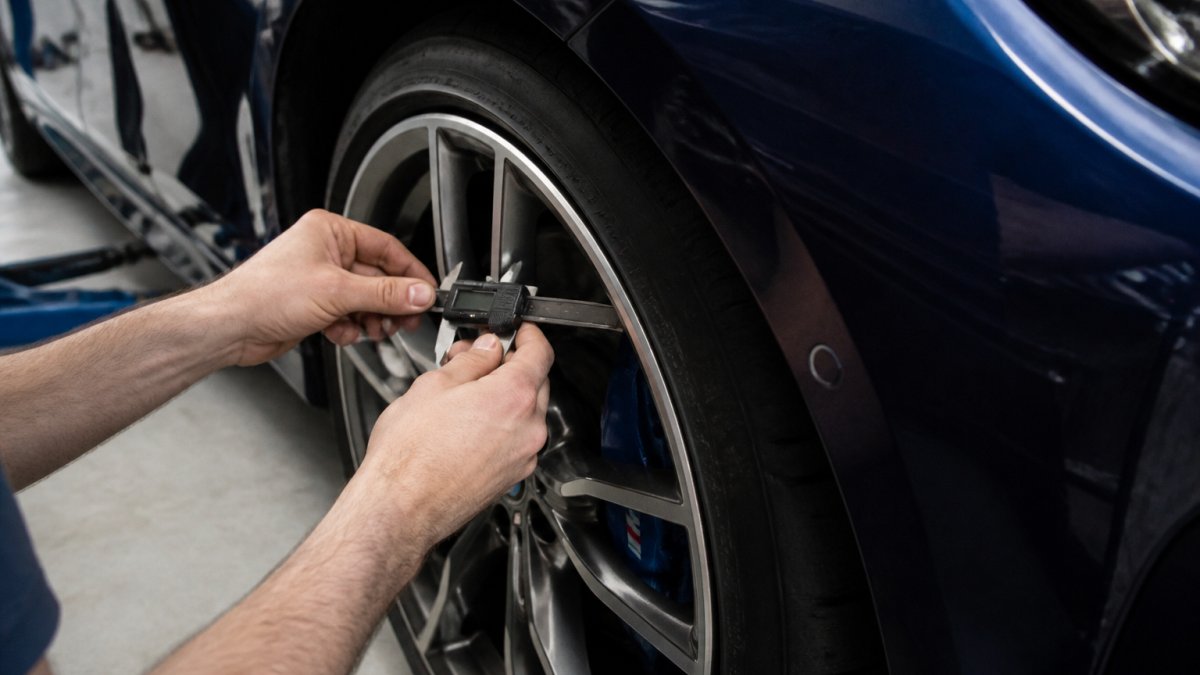
Here is how each one works:
- Wheel diameter. The M340i commonly runs 19-inch wheels from the factory. Going up or down changes tire sidewall, brake clearance, and speedometer accuracy.
- Wheel width. Wider wheels need more room inside the arch and against the strut. A half-inch change can be the difference between a clean fit and liner contact.
- Wheel offset. Measured in millimeters, offset decides how far the wheel sits in or out. Too little offset pushes the wheel toward the fender; too much pulls it toward the suspension.
- Bolt pattern. The G20 M340i uses a 5x112 bolt pattern. A wheel drilled for 5x120 will not mount, regardless of what the listing title says.
- Center bore. The hub register on the M340i is 66.6 mm. A wheel with a larger bore needs hub-centric rings to avoid vibration; a smaller bore will not seat at all.
- Brake caliper clearance. Spoke profile, not just offset, determines whether the wheel clears the caliper face. Large factory and aftermarket calipers need a spoke design with enough internal clearance.
Front and rear fitment are checked separately. The M340i can run a staggered setup, where the rear wheels are wider than the front.
Brake clearance deserves its own measurement. A wheel that clears the hub can still foul the caliper face or the inner barrel.
Hub-centric fitment is the other quiet failure point. A wheel that is not hub-centric, or that lacks the correct centering ring, can torque down off-center and produce a vibration that feels like a balance problem.
If you are comparing a square setup against a staggered one, decide before you buy tires. A square setup lets you rotate front to rear and simplifies winter tire planning; a staggered setup follows the factory performance geometry more closely but locks you into two tire sizes. Neither is wrong, but the choice changes every downstream fitment number.
Step 3: Match BMW M340i Tire Size to Your Wheels
BMW M340i tire size must match the wheel it's mounted on, or handling and safety both suffer. The tire's width, aspect ratio, and diameter all need to suit the rim.
Use this order:
AWE Tuning 2019+ BMW M340i (G20) Non-Resonated Touring Edition Exhaust - Quad →
- Read the tire sidewall: width, aspect ratio, and rim diameter.
- Confirm the tire's approved rim width range, usually printed by the maker.
- Match front and rear pairs to your staggered or square setup.
- Check load and speed ratings suit the car.
A winter tire package is where this matters most. Many owners run a smaller diameter wheel for winter, which means a different tire size entirely. Buy the wheel and tire package mounted and balanced, and you skip the guesswork.
Step 4: Verify BMW M340i Exhaust Fitment
BMW M340i exhaust fitment depends on year range, drivetrain, and whether your car runs a stock or aftermarket downpipe. The B58 engine is shared, but the piping behind it isn't always identical.
Check these before you buy:
- Year range. Confirm the listing covers your exact model year.
- Drivetrain. Some systems are listed for both xDrive and RWD, others aren't.
- Downpipe status. Resonated and non-resonated systems suit different setups.
- Tip style. Quad tips and factory-tip-retention versions are separate products.

If you're still deciding on a system, our guide on how to choose the right exhaust for BMW covers the sound, material, and legal questions in more depth.
Step 5: Check Non-Wheel Parts Fitment and OEM Numbers
Non-wheel parts are where fitment gets quietly complicated. Intakes, brackets, sensors, and exhaust components often look identical but carry different part numbers by year, drivetrain, and emissions configuration. The fix is a repeatable verification process, not a single check.
Work through these steps in order:
- Decode the VIN. The 17-character VIN identifies model year, plant, and build configuration. Use it to confirm the car's exact build rather than relying on the registration date or the seller's description.
- Pull the OEM part number. Find the original part number for the component on your car, either from the part itself, a dealer parts lookup, or a parts catalog that accepts VIN input.
- Cross-reference the seller's number. Compare the seller's part number against the OEM number and against any supersession chain. Manufacturers replace part numbers over time, so a superseded number can still be correct.
- Confirm the listing names your year, model, drivetrain, and emissions standard. A listing that says "M340i" without a year range is unconfirmed.
- Check the fitment notes. Emissions-related parts, in particular, can be restricted by market and build standard. A part that fits a 2020 car may not fit a later build with different emissions hardware.
Consider the aFe Momentum GT Cold Air Intake System w/Pro 5R Filter 2020-2023 BMW M340i (G20) 3.0 L6 (t) N58 | 50-70060R.

Verify the VIN against the part, not just the model name. If a listing gives no year range at all, treat it as unconfirmed. If a listing gives a year range but no drivetrain, treat it as partially confirmed and ask. For a deeper look at spotting counterfeit or mislabelled parts, see our guide on how to identify fake car parts.
The same process applies to suspension, brakes, and exhaust.
Common Mistakes to Avoid
Fitment failures repeat. Here are the ones we see most, and how to sidestep them.
| Mistake | | --- | --- | | Buying by model name only | | Ignoring offset | | Assuming front fits rear | | Skipping brake clearance | | Trusting a vague listing |
| Why It Happens |
|---|
| "M340i" feels specific enough |
| Diameter and width get all the attention |
| Staggered setups are common |
| Wheels clear the hub, not the caliper |
| No year range stated |
| The Fix |
|---|
| Confirm year, generation, drivetrain |
| Check offset in millimeters |
| Check front and rear separately |
| Measure spoke-to-caliper gap |
| Ask for the OEM number |
One more: don't assume a part that fits your engine fits your car. If warranty is a concern, our guide on tuning the BMW B58 without voiding warranty covers what to watch for.
Our team answers fitment questions directly. That's the difference between a part that arrives and a part that fits.
Fitment errors cost time, return shipping, and sometimes a weekend in the garage.
Frequently Asked Questions
How do I check whether a part fits my BMW M340i?
Start with your VIN and the part's OEM number, then confirm the model year, generation (G20), and drivetrain (RWD or xDrive). For wheels and tires, check diameter, width, offset in millimeters, and brake clearance. For exhausts, confirm the downpipe configuration and tip style. A fitment guarantee from the seller is only useful if you've verified the vehicle configuration matches the listing, so check compatibility before checkout rather than after delivery.
Do BMW M340i parts vary by model year?
Yes. The G20 M340i ran from 2020 onward, and mid-cycle changes affect some parts. A cold air intake like the aFe Momentum GT fits 2020-2023 M340i models, while the Injen EVO1108 listing covers 2020-2024. Exhaust listings such as the AWE Touring Edition cover 2020-2024 M340i and M340i xDrive. Always match the part's listed year range to your car rather than assuming all G20 years are identical.
How can I confirm wheel and tire fitment for a BMW M340i?
Check wheel diameter, width, and offset in millimeters against your stock setup, then confirm brake caliper clearance and hub bore. A staggered setup uses different front and rear dimensions, so verify both ends separately. Tire size must match the wheel width and keep the overall rolling diameter close to stock to avoid rubbing and speedometer error. A wheel and tire package that arrives mounted and balanced removes one variable, but you still need to confirm the specs fit your year and drivetrain.
How do I verify that an exhaust system fits my BMW M340i?
Confirm the listing covers your model year and whether your car is RWD or xDrive, since piping routes can differ. Check whether the system is designed for a stock or aftermarket downpipe: the AWE Touring Edition is recommended in non-resonated form for a stock downpipe and resonated if you run an aftermarket one. Also confirm tip style and valve functionality, like the MagnaFlow SPEQ Series that retains OEM valve control, before ordering.
