
How to Choose the Right Exhaust for BMW | 2026 Guide
Table of Contents
- Start With Your BMW Chassis, Engine, and Model Year
- BMW Exhaust System Types: Cat-Back, Axle-Back, and Header-Back
- BMW Exhaust Pipe Diameter and Flow: What Size Actually Helps
- Exhaust Sound, Tone, and Drone on a Daily-Driven BMW
- The Best Exhaust for BMW: Matching the System to Your Driving Plans
- Emissions, Inspections, and Warranty: What to Check Before Install
- Installation, Ownership Cost, and a Final Checklist
- Frequently Asked Questions
Last Updated: October 10, 2026
Start With Your BMW Chassis, Engine, and Model Year
The fastest way to buy the wrong part is shopping by brand name alone.
Chassis code is BMW's internal name for a generation: G20 is the current 3 Series sedan, G80 the M3, F30 the previous 3 Series.
Engine code tells you what sits under the hood.
Model year matters because BMW updates mounts, hangers, and valving mid-cycle. A 2021 and a 2023 M440i can take different hardware.
Check your driver's door jamb sticker or VIN decoder before you browse anything.
Why G20, F30, and G80 Exhausts Are Not Interchangeable
Exhaust systems follow the body, not the badge. The G20 and G22 share a platform, so M340i and M440i systems often swap; the F30 sits on an older platform with different hanger points and tunnel clearance.
Length is the obvious difference; hanger location, flange angles, and tip spacing are what catch people out. A system can bolt to the downpipe and still sit crooked at the bumper.
This is why a listing that says "fits 3 Series" tells you almost nothing.
Reading Fitment Notes Before You Buy
Fitment notes are the part of the listing most buyers skim. Read them twice.
Look for:
- Exact chassis codes listed (G20, G22, G23)
- Engine code (B58, S58, N55)
- Model year range
- Drive type (rear-wheel drive vs xDrive)
- Whether factory tips are reused or replaced
If a listing names your chassis, engine, and year range, you are in good shape. If it says "BMW 3 Series" and stops there, ask before ordering.
BMW Exhaust System Types: Cat-Back, Axle-Back, and Header-Back
Three system types cover almost every BMW upgrade, and the difference is where the new piping starts.
Axle-back replaces only the rear muffler and tips, behind the rear axle. Cheapest and easiest, but sound changes and flow barely do.
Cat-back replaces everything from behind the catalytic converter to the tips.
Header-back replaces the headers, mid-pipe, and rear section. Biggest power move, biggest commitment, usually means tuning and often giving up street legality.
BMW Exhaust Pipe Diameter and Flow: What Size Actually Helps
Bigger pipe is not automatically better. Diameter sets how fast exhaust gas moves, and speed matters as much as volume.
Exhaust gas leaves the engine in pulses, not a steady stream.
For most BMW inline-sixes running stock or mild boost, a well-matched system uses dual 3-inch piping. That is the size AWE builds into its Touring Edition systems for the B58.

The real gain comes from removing restrictions, not adding width. Mandrel bends, a smooth merge, and straight-through mufflers do more than an oversized pipe.
Single vs Dual Exhaust Layouts
Single exhaust runs one pipe from the engine back. Dual exhaust splits into two paths, either from the manifold or further downstream.
BMW's turbo sixes typically run a single downpipe that splits into dual rear sections; that split is why you see quad tips on an M340i.
Dual layouts flow better at high rpm and look the part, but weigh and cost more.
Matching Pipe Size to Your BMW Engine
A common pattern across BMW platforms:
- N20 / N26 four-cylinder (F30 328i, F22 228i): single 2.5 to 3-inch piping is plenty. Going wider than 3-inch on a stock turbo usually costs low-end torque.
- N55 single-turbo six (F30 335i, F22 M235i): dual 2.5 to 3-inch piping. The N55 responds well to a well-merged cat-back; oversized piping tends to add drone without adding much power.
- B58 single-turbo six (G20 M340i, G22 M440i, F30 340i): dual 3-inch piping is the sweet spot for stock or mild boost. This is the size most aftermarket systems are built around because it matches the turbo's flow without killing velocity.
- S55 / S58 twin-turbo six (F80 M3, G80 M3): dual 3-inch or larger piping, often with an X-pipe or H-pipe to balance the two banks. These engines move more air and tolerate, even benefit from, a wider system.
If unsure, match the diameter the aftermarket brand engineered for your chassis. They have done the flow testing; guessing wider is how you end up with a car that feels slower around town than stock.
Exhaust Sound, Tone, and Drone on a Daily-Driven BMW
Sound is where most buyers get burned. A system that sounds incredible in a parking lot video can be unbearable on a two-hour highway drive.
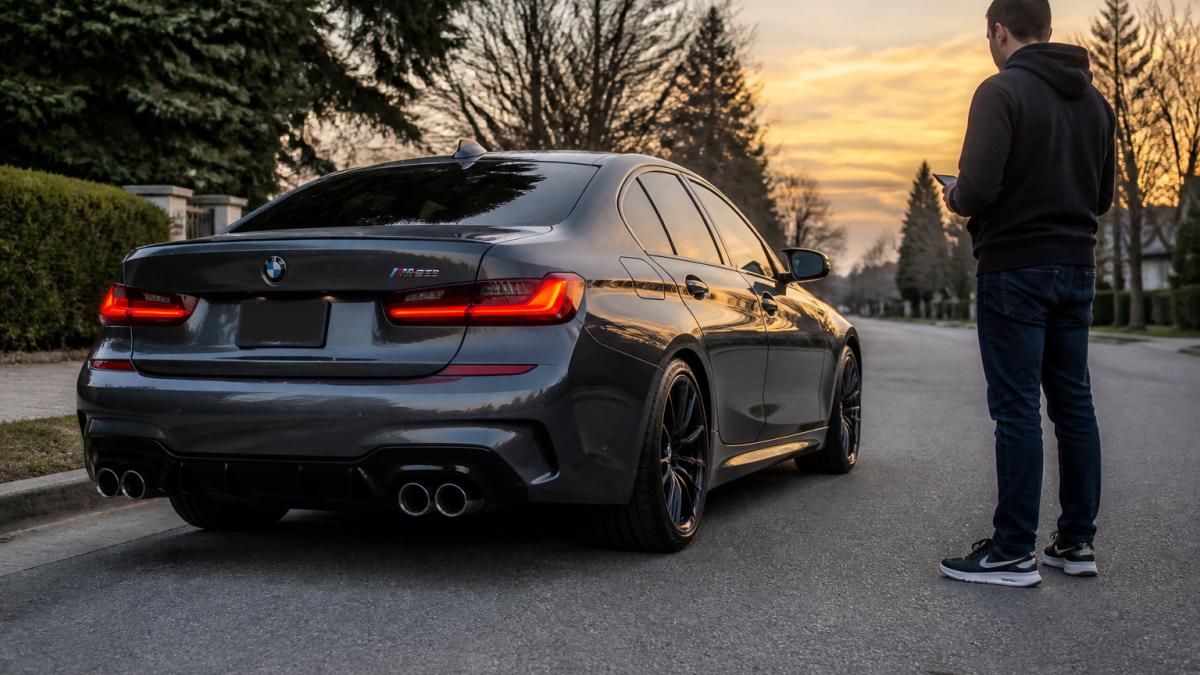
Drone is a low, constant hum at cruising rpm and the number one complaint from owners who bought purely on volume.
AWE Non-Resonated Touring Edition Exhaust for G2X M340i / M440i | 3015-43156 →
Look for systems with built-in drone control. AWE's 180 Technology® targets and cancels drone-prone frequencies, which is why its Touring Edition keeps a deep note without the highway hum.

How BMW Engines Sound Different From Each Other
Tone is not one thing across the BMW range. Each engine family has its own character, and your exhaust either flatters it or fights it.
- N20 / N26 four-cylinder: Raspy and buzzy by nature. A resonated cat-back smooths it out; a straight-through system amplifies the rasp and is the most common source of buyer's remorse on 328i and 228i builds.
- N55 single-turbo six: Smooth, deep, and slightly muted from the factory. A cat-back unlocks a rich, round note without much risk of harshness. This is one of the easiest BMW engines to get right.
- B58 single-turbo six (M340i, M440i, 340i): The modern benchmark. Deep, full-bodied, with a slight burble on decel. A resonated cat-back keeps it refined; a non-resonated system with an aftermarket downpipe pushes it toward aggressive without tipping into rasp.
- S55 / S58 twin-turbo six (M3, M4): Sharper and more metallic. These engines sound best with a system that preserves the twin-bank character; an X-pipe or H-pipe crossover helps. Straight-pipe setups on S55 cars are notoriously droney at cruise.
Tone matters as much as volume. A full-bodied inline-six note reads as expensive. A raspy, hollow sound reads as cheap, no matter how loud it is.
Drone Risk by Configuration
Drone is not random. It follows the configuration:
- Axle-back, resonated: lowest drone risk. The factory mid-pipe and resonator stay in place.
- Cat-back, resonated: low drone risk. The resonator in the new mid-pipe handles the cruise range.
- Cat-back, non-resonated: moderate drone risk on stock downpipe, higher once you add an aftermarket downpipe.
- Cat-back, non-resonated + aftermarket downpipe: highest drone risk. This is the combination that generates the most 'I love it but my wife hates it' forum posts.
- Header-back / straight-pipe: drone is essentially guaranteed at cruise. Fine for a track car, punishing for a daily.
Here is how the main options compare on the factors that decide daily comfort:
| Factor | Axle-Back | Cat-Back | Header-Back |
|---|---|---|---|
| Sound change | Mild | Full, tunable | Loudest |
| Drone risk | Low | Low with resonator | High |
| Flow gain | Minimal | Strong | Maximum |
| Street legality | Usually fine | Usually fine | Often not |
| Typical cost | Lowest | Mid | Highest |
Valve Control and Cabin Noise
Many modern BMWs ship with an exhaust valve that opens under load and closes at cruise. Systems that retain OEM valve function, like the MagnaFlow BMW SPEQ Series cat-back, keep the quiet highway behavior and the louder on-throttle note. Systems that delete the valve give you one volume all the time, rarely what a daily driver wants. If your car has a factory valve, keeping it is almost always right for a street build.
The Best Exhaust for BMW: Matching the System to Your Driving Plans
Daily driver, mostly stock: a resonated cat-back, richer note, better flow, zero drone at highway speed.
Weekend car or track build: a non-resonated or Track Edition system with supporting mods and a tune.
For the B58 cars, we stock the AWE Non-Resonated Touring Edition Exhaust for G2X M340i / M440i.
Already have an aftermarket downpipe? Go with the AWE Resonated Touring Edition Exhaust for G2X M340i / M440i instead.
Prefer to keep your factory tips? The AWE Non-Resonated Touring Edition with OE Tips does exactly that.

If you want a deeper, more aggressive character with valve control retained, the MagnaFlow BMW SPEQ Series Cat-Back runs mandrel-bent 3-inch 304 stainless steel, keeps OEM valve function, and comes with quad 3.5-inch black chrome tips.
Emissions, Inspections, and Warranty: What to Check Before Install
Header-back systems usually remove or relocate emissions hardware, which can fail an inspection and, in many provinces, make the car illegal for road use.
Warranty is the other question. A cat-back does not touch the engine, so it cannot void your powertrain coverage on its own.
For Canadian buyers, Transport Canada's vehicle safety and emissions information is worth a read before any major exhaust change.
Installation, Ownership Cost, and a Final Checklist
Installation is a driveway job for most cat-backs: two to four hours with basic hand tools and ramps or jack stands.
Plan for these costs beyond the system itself:
- New gaskets and clamps
- A resonator conversion kit if you plan a downpipe later
- Shipping and any installation labor
At My Parts Guy MPG Auto, we ship across Canada with no duties or brokerage fees, and we watch competitor pricing so you are not overpaying for the same part.
Use this checklist before you buy:
- Confirmed chassis code (G20, G22, G23, and so on)
- Confirmed engine code (B58, S58, N55)
- Confirmed model year range
- Decided cat-back, axle-back, or header-back
- Checked whether factory tips are reused
- Decided resonated vs non-resonated based on your downpipe plans
- Read the fitment notes line by line
Match the system to the car, match the sound to your commute, and buy once.
Frequently Asked Questions
What is the best exhaust for a BMW?
There is no single best exhaust for every BMW. The right choice depends on your chassis, engine, and how you use the car. For a G20 M340i with the stock downpipe, a non-resonated Touring Edition system gives a deep B58 tone with zero highway drone. If you already run an aftermarket downpipe, the resonated version keeps drone in check. Daily drivers should prioritize drone control and fitment; weekend cars can lean toward a louder, more aggressive tone.
Is a 3-inch or 4-inch exhaust louder on a BMW?
Pipe diameter affects flow and tone more than raw volume. A larger pipe, such as 4-inch, can deepen the sound and raise volume slightly, but it also shifts the power band and can add drone on a daily-driven BMW. Most B58 systems, including the AWE Touring Edition, use dual 3-inch T304L stainless steel tubing with a merge that flows about 65% better than stock. Match diameter to your power goals, not just sound.
Should I choose a cat-back, axle-back, or full exhaust system for my BMW?
A cat-back system replaces everything behind the catalytic converter and is the most common upgrade for BMW owners who want sound and flow without touching emissions hardware. An axle-back changes only the rear section, so it is cheaper and easier to install but delivers smaller gains. A full system, including headers or downpipes, offers the biggest power potential but raises emissions, inspection, and warranty questions. Match the type to your goals and local rules.
Will changing my BMW exhaust affect emissions compliance or inspection requirements?
In Canada, emissions rules vary by province. A cat-back exhaust that keeps the factory catalytic converter in place is generally the safest option for inspections because it does not alter the emissions control system. Removing or replacing the catalytic converter can fail a provincial emissions test and may affect your warranty. Always confirm your province's requirements before buying, and keep the stock parts in case you need to revert for a test.
Choosing an exhaust gets complicated fast when every listing claims to fit every BMW. We take the guesswork out of it. At My Parts Guy MPG Auto, we confirm your chassis, engine, and model year before you order, ship across Canada with no duties or brokerage fees, and back it with decades of hands-on parts knowledge. Subscribe to our newsletter for fitment guides and new arrivals, or reach out and we will help you pick the right system for your build.
