
Performance Exhaust Sound Profiles Explained
Table of Contents
- Performance Exhaust Sound Profiles Explained: What Actually Creates the Tone
- Different Types of Exhaust Sounds: From Deep Rumble to Raw Scream
- How Exhaust Design Affects Sound: Pipe Diameter, Length, and Bends
- Muffler Sound Comparison: Straight-Through, Chambered, and Baffled Designs
- Exhaust Drone at Highway Speeds: Causes and Practical Fixes
- Engine Layout, Materials, and Vehicle-Specific Sound Differences
- Measuring Exhaust Sound: Decibels, Legal Noise Limits, and Standardized Comparisons
- Sound, Performance, Emissions, and Warranty: The Trade-Offs Explained
- Frequently Asked Questions
Last Updated: October 16, 2026
Performance Exhaust Sound Profiles Explained: What Actually Creates the Tone
Exhaust sound is the byproduct of pressure waves moving through your exhaust system, shaped by pipe diameter, pipe length, muffler construction, and engine layout.
Most drivers assume a louder muffler means a better exhaust tone, but that logic falls apart once you understand what happens inside the pipes.
Below, we'll show how pipe dimensions, muffler design, and engine configuration combine to produce everything from a deep rumble to a raw scream, plus how to avoid highway drone.
Different Types of Exhaust Sounds: From Deep Rumble to Raw Scream
Exhaust sound profiles fall into recognizable categories, each tracing back to design choices rather than brand marketing.
Then there's smooth and refined, for drivers who want presence without drawing attention. These profiles rely on packing material and internal chambers to absorb harsh frequencies while preserving low-end character.
What most guides miss: two systems with identical pipe diameter can sound completely different once muffler volume and internal construction change.
How Exhaust Design Affects Sound: Pipe Diameter, Length, and Bends
Exhaust design affects sound by controlling how gases and pressure waves travel from header to tailpipe. Every change to diameter, length, or bend geometry shifts which frequencies get amplified and which get cancelled.
Pipe Diameter and Its Effect on Tone and Loudness
Pipe diameter is the biggest lever on exhaust loudness. Smaller pipes keep exhaust velocity high for a sharper, more focused tone.
The rule: match pipe diameter to engine displacement and power level. A larger diameter system on a V8 sounds fuller and deeper, while the same diameter on a small four-cylinder often sounds hollow and boomy.
Pipe Length, Shape, and Bends: How Flow Characteristics Shape the Note
Pipe length and shape determine where resonance peaks land in the RPM range. Longer runs favor low-frequency resonance, which is why cat-back systems sound deeper than axle-back systems on the same vehicle.
Bends matter more than most realize. Mandrel bends maintain consistent internal diameter through the curve, preserving flow and preventing the turbulence that creates rasp.
Muffler Sound Comparison: Straight-Through, Chambered, and Baffled Designs
Muffler design determines how much sound energy gets absorbed, reflected, or cancelled before reaching the tailpipe. Three architectures dominate the aftermarket: straight-through, chambered, and baffled.
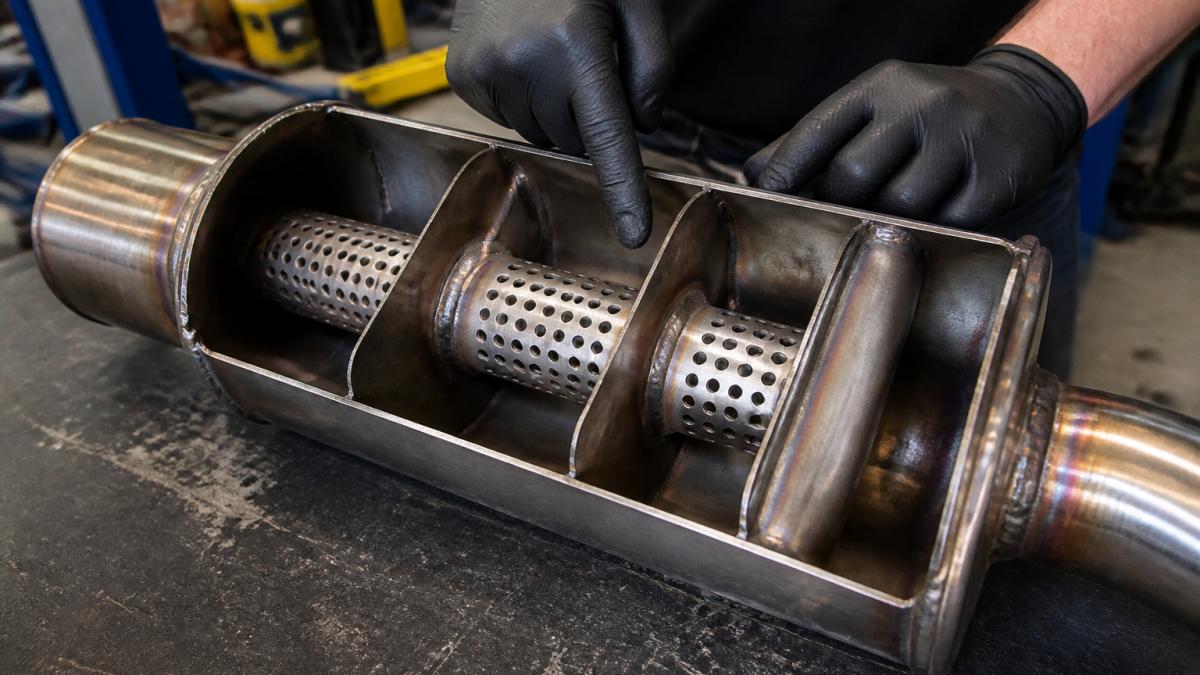
A straight-through muffler uses a perforated pipe wrapped in packing material; exhaust flows directly through with minimal restriction, producing maximum flow and an aggressive tone.
| Muffler Type | Sound Character | Flow | Best For |
|---|---|---|---|
| Straight-through | Aggressive, raw | Highest | Max power, track use |
| Chambered | Deep, controlled | Moderate | Classic tone, street |
| Baffled | Quiet, tame | Lowest | Stock-replacement quiet |
Packing Material, Perforated Pipe, and Sound Absorption
Packing material separates a tolerable exhaust from a droning one. Fiberglass and stainless steel wool wrap the perforated pipe and absorb high-frequency sound energy. Over time, packing breaks down from heat cycling, which is why some systems get louder with age; higher-quality systems use denser, more heat-resistant packing that holds its acoustic profile longer.
Exhaust Drone at Highway Speeds: Causes and Practical Fixes
Exhaust drone at highway speeds happens when the system's resonance frequency matches your engine's cruising RPM, typically between 1,800 and 2,500 RPM, a constant, fatiguing cabin hum no music drowns out.
Fixes range from simple to structural:
- Add a Helmholtz resonator or J-pipe tuned to cancel the offending frequency
- Switch to a muffler with internal chambers that break up standing waves
- Reduce pipe diameter slightly to shift resonance out of the cruising range
The best fix is choosing the right system from the start. Borla's Polyphonic Harmonizer technology, for example, uses pipes of different diameters and lengths inside the muffler to create multiple harmonizing exhaust notes, delivering an aggressive ATAK sound with no drone inside the vehicle.

Engine Layout, Materials, and Vehicle-Specific Sound Differences
Engine layout shapes exhaust sound before any aftermarket part touches the car. Cylinder configuration, firing order, and displacement set the baseline acoustic profile.
Exhaust material plays a supporting role. Stainless steel and titanium resist corrosion and hold their shape under heat, but transmit sound differently than mild steel; thinner-wall titanium systems often sound brighter and more metallic.
Vehicle-specific differences matter too.
Measuring Exhaust Sound: Decibels, Legal Noise Limits, and Standardized Comparisons
Most exhaust marketing describes tone with adjectives, fine for shopping, but it tells you nothing about whether a system will pass inspection, annoy neighbors, or drone on your commute. To compare profiles credibly, you need to understand how sound is measured and what the numbers represent.
What a Decibel Reading Actually Means
A decibel (dB) is a logarithmic ratio, not a linear unit, which compresses huge ranges into small numbers:
Borla 2024 Ford Mustang GT 5.0L V8 w/ Active Exhaust ATAK Cat-Back Exhaust →
- An increase of 3 dB represents roughly a doubling of sound energy.
- An increase of 10 dB is perceived by most listeners as roughly twice as loud.
- So a system reading 95 dB is not "5% louder" than one at 90 dB; it carries meaningfully more acoustic energy and is noticeably louder in the cabin and to anyone nearby.
That's why two systems advertised as "aggressive" can feel completely different in person; a 4 dB spread is a real, audible gap.
How Sound Level Is Measured
A standardized reading depends on four variables:
- Microphone distance and angle, commonly measured at a set distance from the tailpipe (often around 0.5 m / 20 in) and at a specified angle, such as 45 degrees off the outlet.
- Engine speed, readings are typically taken at a defined RPM, and sometimes at idle and at a target cruise or wide-open-throttle point.
- Load condition, a free-revving engine in neutral reads differently than the same engine under load on a dyno or road.
- Environment, reflective surfaces, wind, and background noise all shift the number.
A manufacturer's dB claim is only useful if you know the test conditions behind it. A figure quoted at idle tells you almost nothing about behavior at 2,500 RPM under load, where drone and highway fatigue actually live.
Why Legal Limits Are Local, Not National
There is no single national exhaust decibel standard. Noise enforcement comes from a mix of:
- Provincial highway traffic legislation, which sets equipment and muffler requirements for vehicles on public roads.
- Municipal noise bylaws, which often govern time-of-day and neighborhood noise.
- Provincial vehicle inspection programs, where applicable, which may test or visually assess exhaust equipment.
A system marketed as "street legal" in one jurisdiction may not satisfy the rules where you drive. Before buying, check your provincial highway traffic act and municipal bylaws for the decibel threshold and equipment language that applies to you. Enforcement is handled by local police and provincial authorities, so verify locally.
How to Compare Sound Profiles Credibly
If you're comparing systems or watching sound clips online, apply the same discipline a tester would:
- Match the recording conditions. Consistent microphone, distance, angle, and placement relative to the tailpipe.
- Match the engine state. Same RPM points, same load condition (idle, cruise, wide-open throttle), same warm-up state.
- Match the vehicle. A clip recorded on a different engine, displacement, or firing order tells you very little about how the same exhaust will sound on yours.
A useful comparison covers at least three states: idle, steady cruise in the drone-prone range, and acceleration under load. A clip showing only a neutral rev is a tone sample, not a real-world prediction.
The Practical Takeaway
Use decibel figures as a relative guide, not an absolute promise. Use standardized clips to compare tone. And confirm the legal threshold where you actually drive before committing to a system.
Sound, Performance, Emissions, and Warranty: The Trade-Offs Explained
Every exhaust decision trades one quality for another. More flow usually means more sound; more sound absorption usually means more restriction. Any modification also carries warranty and emissions implications. The goal isn't maximizing any single factor; it's picking the combination that fits how you actually drive.
The Four Axes You're Balancing
Think of an exhaust choice as a point on four axes:
- Sound, tone character and volume, including drone behavior at cruise.
- Performance, flow and scavenging, which affect power delivery across the RPM range, not just peak numbers.
- Emissions and compliance, whether factory emissions equipment is retained and whether the system will pass any applicable inspection.
Improving one axis usually costs you on another. The skill is knowing which trade-offs you can live with.
How the Trade-Offs Break Down in Practice
| Priority | Design Choice | Trade-Off |
|---|---|---|
| Maximum sound | Straight-through, large diameter | Drone risk, noise enforcement risk |
| Maximum power | Mandrel bends, high-flow cat | Louder, emissions compliance risk |
| Daily comfort | Chambered muffler + resonator | Slightly less peak flow |
| Warranty safety | Axle-back, factory cat retained | Less aggressive tone |
Power Delivery, Not Just Peak Power
A common misconception is that "more flow equals more power everywhere." In reality, pipe diameter and back pressure interact with engine scavenging, and going too large can cost low-end torque even as it frees top-end flow, strong at high RPM, soft off the line.
For a daily driver, mid-range response matters more than a peak number you rarely reach. Match pipe diameter to your engine's displacement and power level rather than chasing the largest size.
Emissions Equipment and Inspection Rules
Emissions components, particularly the catalytic converter, are most likely to create compliance problems. Two practical points:
- Retaining the factory catalytic converter keeps you closest to the vehicle's original emissions configuration.
- Replacing or removing emissions equipment can put you outside the rules that apply where you drive and may affect inspection outcomes.
Rules and inspection requirements vary by province and municipality, so confirm what applies to your vehicle and location before modifying emissions-related parts.
Warranty Implications
Warranty exposure depends on how much of the factory system you replace:
- Axle-back systems replace only the rear section and leave the factory catalytic converter and mid-pipe intact. This is generally the lowest-risk option for warranty-conscious owners.
- Cat-back systems replace more of the factory system, offering more sound and flow but touching more components.
- Modifications that alter emissions equipment carry the greatest risk of affecting warranty coverage on related parts.
Warranty terms differ by manufacturer and failure, so read your vehicle's warranty documentation rather than assuming any modification is automatically covered or void.
A Simple Decision Framework
Work through these questions:
- Where do you drive most? If it's highway commuting, prioritize drone control over peak volume.
- What's your local noise limit? Confirm the applicable threshold before choosing a loudness target.
- Do you have inspections? If so, keep emissions equipment intact.
- Is the vehicle under warranty? If yes, favor axle-back or systems that retain factory emissions components.
- What RPM range matters to you? Match pipe sizing and muffler design to your real-world driving, not to a parking-lot rev.
For drivers who want an aggressive note without the drone, a system like the Borla 2024 Ford Mustang GT ATAK Cat-Back Exhaust System pairs a merge X-Pipe with Polyphonic Harmonizer technology to deliver a clean, full-bodied ATAK sound. If you're not running active exhaust, the S-Type Axle-Back offers the classic S-Type tone with no drone, and Subaru owners chasing a race-inspired note can look at the MBRP WRX Race Profile Cat-Back with its T304 stainless construction and aggressive tone.


Frequently Asked Questions
What are the different types of exhaust sounds?
Most performance exhaust sound profiles fall into a few recognizable categories: deep and throaty (common with larger-displacement V8s and chambered mufflers), smooth and refined (typical of well-tuned systems with packing material), aggressive and raw (straight-through or race-profile designs), and raspy or buzzy (often from unequal-length headers or thin piping). The exhaust note you get depends on pipe diameter, pipe length, muffler construction, and engine layout working together, not any single component.
How do mufflers and resonators change exhaust sound?
A muffler sound comparison comes down to internal construction. Straight-through mufflers use a perforated pipe wrapped in packing material, absorbing high frequencies while letting exhaust flow freely, which produces a smooth but loud tone. Chambered mufflers route gases through internal chambers that cancel specific frequencies, creating a deeper, more controlled note. Resonators are smaller inline units that target drone frequencies without significantly reducing overall volume, so they are often added to tame highway resonance while keeping the aggressive character intact.
Why does my performance exhaust drone at highway speeds?
Exhaust drone at highway speeds happens when exhaust pulses resonate at a frequency that matches your cabin's natural resonance, usually between 1,800 and 2,800 RPM. Contributing factors include large pipe diameter, minimal packing material, and lack of a resonator. Adding a resonator, switching to a muffler with more sound absorption, or choosing a system with drone-canceling technology can reduce it. Systems like the Borla ATAK for the 2024 Mustang GT use Polyphonic Harmonizer technology specifically to deliver an aggressive exhaust tone without cabin drone.
Is a larger diameter exhaust louder?
A larger diameter exhaust is generally louder than a smaller one because the increased pipe diameter moves more exhaust volume with less back pressure, allowing more sound energy to escape. However, diameter alone does not determine loudness. Muffler design, packing material, and whether a resonator is present all play major roles. A smaller diameter system with a straight-through muffler can be louder than a larger diameter system with a well-packed chambered muffler. Matching pipe diameter to your engine displacement and power goals matters more than chasing the biggest size.
