
Do Slotted Rotors Really Improve Braking Performance?
Last Updated: November 17, 2026
Quick Summary
Slotted rotors help in specific conditions rather than improving braking across the board. Their grooves clear gas, dust and water from the pad surface, which can support more consistent pad contact and a sharper pedal feel. They do not guarantee shorter stopping distances, and they can increase pad wear.
- Slots clear gas, dust and water from between the pad and rotor.
- Slotted rotors can increase pad wear because the slot edges act like cutting surfaces.
- A slotted rotor paired with the wrong pad will not deliver a noticeable improvement.
- Most everyday drivers do not need slotted rotors unless wet or dusty conditions are common.
- Confirm year, make, model and trim before buying, since rotor fitment varies.
Table of Contents
- What Slotted Rotors Are Designed to Do
- Slotted vs Smooth Rotors: Where the Real Difference Shows
- Drilled vs Slotted Rotors: Comparison Table and Trade-Offs
- Do Slotted Rotors Wear Pads Faster?
- Best Brake Rotors for Daily Driving, Towing and Track Use
- Is the Upgrade Worth It for Your Vehicle?
- Choosing Slotted Rotors for Your Next Brake Job
- Frequently Asked Questions
What Slotted Rotors Are Designed to Do
Slotted rotors are brake discs with grooves machined into the friction surface. Canadian drivers who ask whether slotted rotors improve braking performance usually want a plain answer: they help in some situations and do little in others. The grooves are meant to clear gas, dust and water from between the pad and rotor, keeping the pad in more direct contact with the metal.
My Parts Guy MPG Auto sells slotted and drilled rotor sets for several Toyota, Acura, Ford and Jeep applications. The short answer is that slotting is a function-specific feature, not a universal upgrade.
Slotted vs Smooth Rotors: Where the Real Difference Shows
Smooth rotors are the standard on most factory brake systems. They are simpler to manufacture and produce predictable pad behaviour in everyday driving. Slotted rotors trade some of that simplicity for better pad-to-rotor contact in specific conditions.
The practical difference shows up in three places: how quickly the pad bites when you first press the pedal, how well the system sheds debris and gas, and how the rotor handles repeated heavy stops. Those are different effects, and they should not be lumped together under the heading of "better braking."
Pad-to-Rotor Contact and Initial Bite
Initial bite is the feeling of the pedal engaging the pads. Slots can help keep the pad surface clean, which supports more consistent contact. A clean pad surface is the main reason slotting is associated with a sharper response.
That said, initial bite depends heavily on pad compound and pedal feel. A slotted rotor paired with the wrong pad will not deliver a noticeable improvement. Matching the rotor and pad is more important than the groove pattern alone.
Gas, Dust and Water Removal
Under heavy braking, gases form at the pad surface. If they cannot escape, they can reduce contact and contribute to brake fade. Slots give those gases a path out. The same channels help move water and brake dust away, which matters most in wet weather.
Baer Claw slot-only rotors are described by the manufacturer as providing an escape route for gases and dust between the pad and rotor, which supports a more consistent pedal feel and reduced brake fade.
Drilled vs Slotted Rotors: Comparison Table and Trade-Offs
Drilled rotors have holes cast or machined through the disc. Slotted rotors have grooves machined into the friction surface. Many buyers treat the two as interchangeable performance upgrades, but they solve different problems and carry different risks. Drilled designs are usually marketed around cooling and gas evacuation, while slotted designs focus on keeping the pad face clean. Neither feature guarantees a shorter stopping distance on every vehicle.
| Rotor Type | Main Design Goal | Typical Strength | Main Trade-Off |
|---|---|---|---|
| Smooth (standard) | Simple, predictable wear | Quiet, long pad life, lowest cost | Less pad-surface clearing |
| Slotted | Clear gas, dust, water | Consistent pad contact under hard use | Possible faster pad wear |
| Drilled | Shed heat, vent gases | Cooling under sustained load | Cracking risk around holes in some uses |
| Drilled and slotted | Combine both features | Broad performance profile | Highest cost and complexity |
How the Two Designs Actually Differ
A slot is a shallow channel that wipes the pad face as the rotor turns. It gives gas, dust and water somewhere to go, and it continuously refreshes the pad surface. A drilled hole does the same clearing job plus adds surface area for airflow, which is why drilled rotors are associated with cooling.
A common pattern in performance driving is that drilled rotors are chosen for looks and light track use, while slotted rotors are chosen where pad consistency matters more than weight savings. That is a generalization, not a rule, caliper design, vehicle weight, pad compound and cooling airflow all change the outcome.
What the Claims Do and Do Not Support
Most supplied descriptions of drilled and slotted rotors make general performance claims without specifying test conditions, stopping distances or repeatable data. Because a sharper pedal is only useful when the brake hardware fits and operates as intended, Rubber Lab Industries connects that assessment with checking wheel clearance around the calipers.
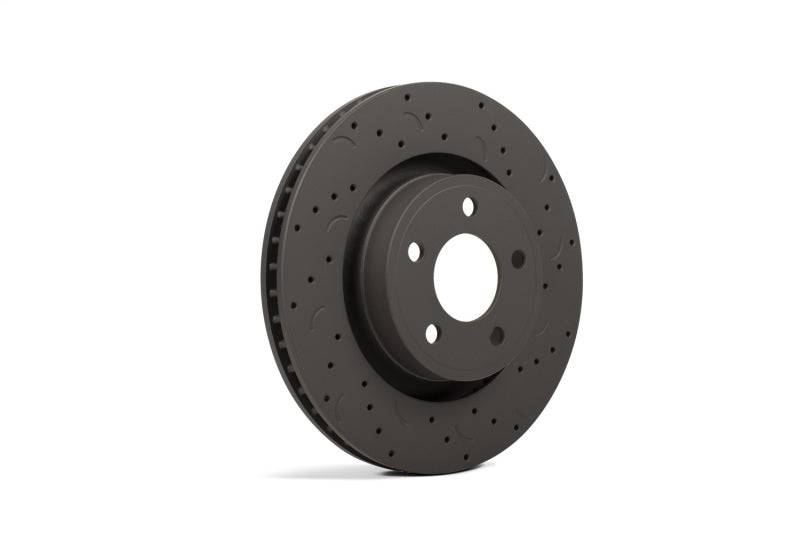
For a Hawk Talon drilled and slotted set, such as the HTC4918 for listed Toyota 4Runner, FJ Cruiser and Tacoma models, the combined design is engineered to fit the vehicle's current braking system without modification. Check your vehicle's fitment before ordering, because the same brand can offer different rotor types across model years, and a rotor that fits one trim may not fit another.
Do Slotted Rotors Wear Pads Faster?
Yes, slotted rotors can increase pad wear, but the effect varies with pad material and driving style. The slot edges act like small cutting surfaces against the pad, and that action adds wear over time. Drivers who mostly commute will usually see a modest difference. Drivers who brake hard and often may see more.
Pad choice affects this trade-off. Ceramic pads generally produce less dust and can be gentler on rotors, while semi-metallic pads tend to bite harder and suit demanding use. You can compare ceramic and semi-metallic options side by side before deciding. Our best brake pads for mountain driving guide shows which pads suit a performance-oriented setup.
Best Brake Rotors for Daily Driving, Towing and Track Use
The right rotor depends on how the vehicle is used, and the honest answer is that most drivers do not need slots. A use-case decision guide reconciles the conflicting advice: slots help when the pad face is being contaminated or overheated repeatedly, and plain rotors are the more practical choice when quiet operation, pad life and cost matter most.
Daily Driving
For commuting and errands, a smooth or lightly slotted rotor usually offers the best balance of quiet operation, pad life and cost. Slotted designs make more sense for drivers who want a sharper feel or who regularly drive in wet or dusty conditions. In normal city driving the brakes rarely get hot enough for gas buildup to be the limiting factor, so the slot's main benefit is keeping the pad surface clean in rain and road grime. If your current brakes work well and you rarely brake hard, the upgrade may not justify the cost.
Towing and Heavy Loads
Towing changes the picture because heavier loads increase heat and extend stopping distances. A rotor that manages heat and debris well can reduce fade on long descents, but the rotor is only one part of the system. Vehicle weight, trailer weight, tire grip, caliper condition and brake fluid condition all matter more than the groove pattern. A common pattern is that drivers who tow upgrade pads and fluid first, then consider slotted rotors if fade persists on repeated descents. Our guide to performance parts for truck towing covers the broader upgrade options for heavy use.
Track and Repeated Hard Stops
For track use, drilled and slotted rotors are more common, but they require more frequent inspection for cracks and pad wear. The benefit on track is consistency across repeated stops rather than a single shorter stop. Watch out: a slotted rotor paired with a pad that is not rated for the heat will wear quickly and may not deliver the consistency the driver expects. Match the pad to the rotor and the duty cycle, and inspect both after every track event.
Total Ownership Cost and Service Life
The pad-wear trade-off is the part everyday buyers feel most. Slotted rotors can increase pad wear because the slot edges act like small cutting surfaces against the pad. That means more frequent pad replacement, and the rotor itself may need replacement sooner if it wears below specification. Compare purchase price, pad replacement frequency, rotor lifespan and maintenance needs before deciding. A slotted set typically costs more than a standard replacement, and the improvement in everyday braking may be small, so the upgrade is easiest to justify when the vehicle is used in wet, dusty or repeated-hard-stop conditions where the slot does real work.
Vehicle-Specific Fitment and System Limits
Rotor and pad compatibility, caliper design, vehicle weight, tire grip, ABS and manufacturer specifications all determine whether slots help. A slotted rotor cannot overcome a tire that lacks grip or a caliper that is not sized for the load. Confirm your year, make, model and trim before buying. The Baer Claw rotors are listed for specific Ford F-150 and Jeep Wrangler applications, so a rotor that fits one truck may not fit another. If you need more stopping capacity than a rotor change can provide, a larger brake kit is the next step; our comparison of big brake kits and stock brakes explains what changes when you move beyond rotor design.
Is the Upgrade Worth It for Your Vehicle?
Whether the upgrade is worth the money depends on your vehicle, your driving and your budget. A slotted rotor set typically costs more than a standard replacement, and the improvement in everyday braking may be small. If your current brakes work well and you rarely brake hard, the upgrade may not justify the cost.
Consider a larger brake kit if you need more stopping capacity. Our comparison of big brake kits and stock brakes explains what changes when you move beyond rotor design. For fitment, confirm your year, make, model and trim before buying.
Choosing Slotted Rotors for Your Next Brake Job
Start by matching the rotor to your vehicle and driving. Confirm fitment by year, make, model and submodel. Choose pads that suit the rotor design, and plan to inspect both components at each service interval.
Our current catalogue includes Hawk Talon drilled and slotted sets for several Toyota and Acura applications, along with Baer Claw slot-only rotors for Ford and Jeep. Hawk Talon 2013 Acura ILX set is listed at $288.49 CAD and the 2003 Toyota 4Runner set at $304.49 CAD, with Baer Claw rear rotors listed from $404.99 CAD. Compare the specifications on each listing before choosing.
Shop slotted rotors at My Parts Guy MPG Auto and subscribe for updates on new brake parts and fitment guidance.
Frequently Asked Questions
Do slotted rotors improve braking performance?
Slotted rotors can improve braking consistency, mainly by channelling gas, dust and water away from the pad-to-rotor interface. The gain is most noticeable when brakes are hot, wet or heavily used. For most daily driving, the difference in stopping distance is small, so a slotted rotor is better understood as a consistency and maintenance benefit than a large jump in stopping power. Results depend on pad compound, rotor material and vehicle, so compare the specific parts you are considering rather than relying on general claims.
Do slotted rotors wear brake pads faster?
They can. The slot edges act like a light abrasive on the pad surface, so pad wear may increase somewhat compared with a smooth rotor. How much depends on pad compound, driving style and how aggressively the slots are cut. Drivers who mostly commute will usually see little practical difference, while frequent hard stops or track use make the added wear more noticeable. Checking pad thickness at each service is the simplest way to keep track of it.
Are drilled or slotted rotors better for performance driving?
Slotted rotors are the more common choice for performance driving because they manage debris and gas without creating the crack-prone holes that drilled rotors have. Drilled rotors are often marketed for heat dissipation, and drilling can reduce the rotor's mass available for heat storage. Many enthusiasts choose slotted or a combination design for street-performance use, and reserve drilled designs for specific applications.
Should I replace my brake pads when I install slotted rotors?
It is a good idea to check pad condition and replace pads if they are worn or if you plan to change pad compound. Bedding in the new rotors and pads according to the manufacturer's procedure helps them seat evenly. Installing new rotors on old, uneven pads can shorten rotor life and reduce braking consistency, so a combined brake job is often the most reliable approach.

