
Big Brake Kit vs Stock Brakes: What Changes
Quick Summary
A big brake kit replaces the stock calipers with larger multi-piston units and usually upgrades to larger rotors, raising clamping force and heat capacity. It mainly improves repeat-stop consistency and resistance to brake fade, not single-stop distance. Stock brakes suit daily driving, while a big brake kit suits track use, towing or heavy loads.
- A big brake kit adds clamping force and friction area, raising the system's capacity to absorb heat.
- Repeat-stop consistency matters more for street drivers than a small single-stop distance gain.
- Check wheel clearance, rotor diameter and ABS compatibility for your model year before buying.
- A kit can shift front-to-rear brake bias, so confirm whether it preserves the stock balance.
- For a daily driver, a pad and rotor upgrade on stock calipers often wins on total cost.
Table of Contents
- What Stock Brakes Are Designed to Do
- What a Big Brake Kit Includes
- Stopping Distance Versus Repeat-Stop Performance
- Wheel Clearance, Rotor Size and Fitment
- Brake Pad and Rotor Upgrade vs Big Brake Kit
- Total Cost of Ownership and Installation Considerations
- Choosing the Right Brake Upgrade for Your Car
- Frequently Asked Questions
What Stock Brakes Are Designed to Do
Last Updated: November 5, 2026
Stock brakes are engineered to balance stopping power, cost, noise, dust and longevity for the widest possible range of drivers. A big brake kit, by contrast, is built to push the limits of that balance. Understanding the difference starts with what the factory system is actually asked to do.
Most passenger cars leave the factory with a single-piston floating caliper at each wheel, a vented rotor sized for typical use, and a semi-metallic or organic pad. That setup is tuned for daily driving in Canadian conditions: cold starts, wet roads, and the occasional emergency stop. It is not tuned for repeated high-speed stops from a track session.
Stock brakes also share a compromise with the rest of the car. The pedal feel, the master cylinder output, and the ABS calibration all assume the factory rotor and pad combination. Change one component and the others may no longer behave as the engineers intended.
Watch out: a larger caliper alone does not improve braking. Without matched pads and fluid, a mismatched setup can give a spongy pedal or uneven bite.
What a Big Brake Kit Includes
A big brake kit, often called a BBK, replaces the stock calipers with larger multi-piston units and usually upgrades the rotors to a larger diameter. The goal is more clamping force and more friction area, which together raise the system's capacity to absorb heat.
The Wilwood DPHA kit in our catalogue illustrates the typical design. It is a four-piston caliper built from forged billet, with stainless steel pistons, and it bolts to the stock mounts on Honda and Acura models originally fitted with 262mm rotors. The Alcon kit for the F-150 and Raptor pairs six-piston calipers with 347x36mm rotors and is designed to reduce disc temperature rise and pedal effort relative to the stock system, according to its listing.

A complete kit can include calipers, brackets, rotors, pads, and sometimes hard-line or stainless brake hoses. Read the parts list carefully before ordering, since some kits assume you already have the correct hubs, hoses, or master cylinder.
Stopping Distance Versus Repeat-Stop Performance
Stopping distance is what most drivers think of first. A single stop from a moderate speed on a dry road is a poor test of a brake system. Most stock setups can stop a car in a short distance once. The real question is whether they can do it again, and again, without losing effectiveness.
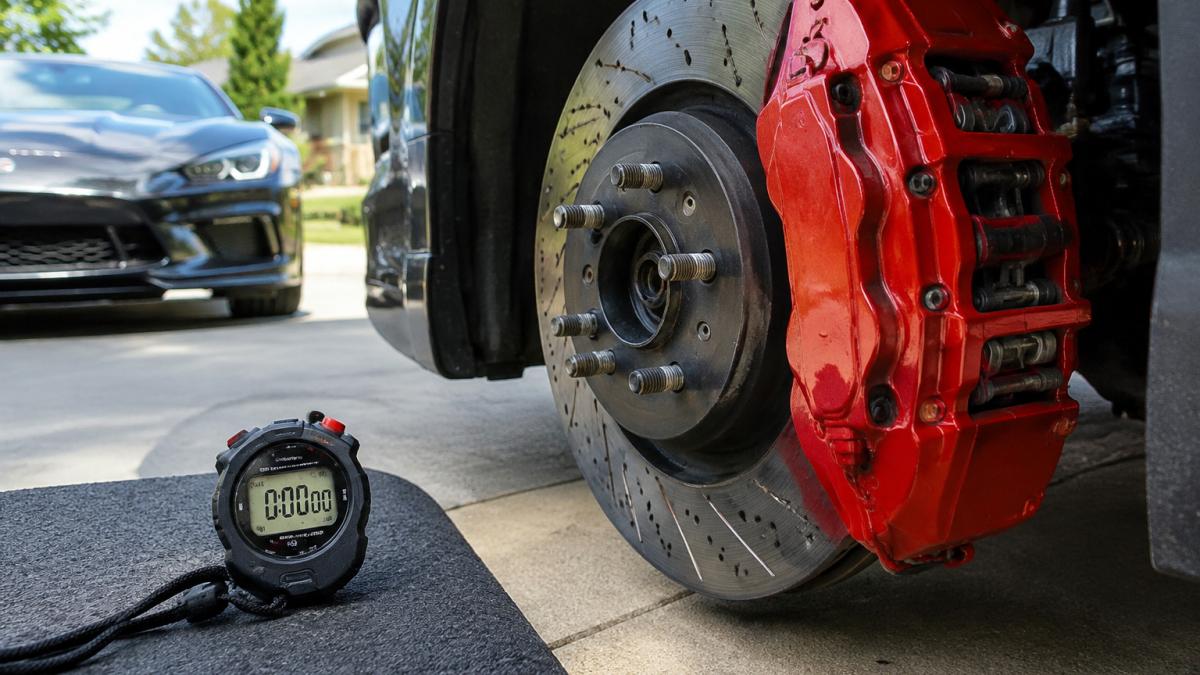
This is the gap most comparisons miss. A bigger rotor and multi-piston caliper can offer more consistent pedal response over repeated stops, even when the single-stop distance gain is small. For street drivers, that consistency matters more than a few metres shaved off one emergency stop.
We recommend judging any upgrade on repeat-stop behaviour, not a single measured stop. A controlled test from a single brake, then five or six stops in succession, shows the difference far more clearly.
Heat Capacity and Brake Fade During Repeated Hard Stops
Brake fade is the loss of stopping power as the braking system overheats. Friction material and fluid both lose effectiveness at high temperature, and the rotor can soak up only so much heat before it stops absorbing more efficiently.
A larger rotor has more mass and more surface area to shed heat. Multi-piston calipers spread clamping force across a larger pad area, which can reduce pad work rate and the heat load per stop. The Alcon listing cites a 10% reduction in disc temperature rise and a 33% reduction in pad work rate compared with the stock system, though those figures come from the manufacturer and should be read as claims rather than independent measurements.
Watch out: fade depends on the whole system. Pads rated for high temperature, fresh high-temperature brake fluid, and proper cooling all matter as much as the caliper.
Wheel Clearance, Rotor Size and Fitment
Fitment is where many upgrades go wrong, and it is more than whether the wheel clears the caliper. A big brake kit changes the hydraulic and electronic balance of the whole system, and the kit has to match the vehicle, not just the brake spec sheet.
Start with physical clearance. A larger rotor and caliper need room inside the wheel barrel, and some factory aluminum wheels will not clear a big brake kit without spacers or a different wheel design.
Then look at hydraulic balance. The master cylinder and proportioning valve are calibrated for the stock caliper piston area and rotor diameter. A kit with much larger pistons can shift front-to-rear brake bias, which changes how the car behaves under hard braking and can make the rear feel loose or the front lock early.
ABS compatibility is the next check. Most modern ABS systems tolerate a well-matched kit, but a significant change in wheel speed sensor tone rings, rotor diameter, or caliper piston area can affect how the ABS and stability control interpret wheel behavior. A kit that is not matched to the vehicle can trigger fault codes or reduce the system's effectiveness in low-traction conditions.
Watch out: mixing a big front kit with stock rear brakes, or buying a used kit designed for a different model, is a common way to end up with a car that stops worse than stock in daily driving even though it has more hardware.
Alcon 09-20 F-150/Raptor Gen1-2 347x36mm Rotors 6-Piston Red Front Brake Kit →
The safe path is a vehicle-specific kit that states its compatibility with your model year, ABS system, and wheel options, installed with a proper bleed and a brake test. If the kit requires a different master cylinder or proportioning valve, factor that into the cost and the install plan.
Brake Pad and Rotor Upgrade vs Big Brake Kit
For many drivers, a full big brake kit is more than they need. A cheaper route is a pad and rotor upgrade on the stock calipers. Performance pads with a higher-temperature compound can improve bite and fade resistance. Higher-quality rotors can improve heat dissipation over the stock part.

The trade-off is that the stock caliper's piston count and clamping force stay the same. A pad upgrade can deliver a meaningful gain for spirited street driving or occasional track days, especially on a car that does not see sustained hard use.
If you track the car regularly, or tow, or drive a heavy vehicle, a full big brake kit usually makes more sense.
Total Cost of Ownership and Installation Considerations
Most comparisons stop at the kit price. That is the smallest part of the story. A big brake kit changes what you pay up front, what you pay every time the pads or rotors wear out, and how much labour the system demands over its life.
Start with the purchase. Listed prices in our catalogue include the Alcon F-150 kit at $4,381.49 CAD, the Wilwood DPHA kit at $921.49 CAD, and the Wilwood AERO6 Corvette kits at $1,683.49 CAD. Add installation labour, brake fluid, a bleed, and any required hoses or hardware before you compare the two paths.
Then look at consumables. Big brake kits often use larger pads and rotors, and those parts can cost more per replacement than stock-sized equivalents. Because pad and rotor costs depend on how each wears and is replaced, a brake pad replacement guide can help clarify which consumables drive the bill.
Fluid and lines matter too. High-temperature brake fluid has a shorter service interval than standard fluid because it absorbs moisture and its boiling point drops over time. Stainless lines are a one-time cost but add to the install. None of these are deal-breakers, but they belong in the budget.
Watch out: a cheap kit with proprietary pads or hard-to-source rotors can cost more over five years than a more expensive kit that uses common consumables. Check pad and rotor availability and pricing before you commit.
Installation complexity varies. A bolt-on kit that reuses the stock mounts and hoses is simpler than one requiring custom brackets, a hydraulic line conversion, or a different master cylinder. You can review a McLeod adjustable multi-piston kit and its included hardware to see what parts to budget for.
The practical takeaway: compare the kit price plus installation plus five years of pads, rotors, and fluid against the same five-year estimate for a pad-and-rotor upgrade on stock calipers. For a daily driver, the stock-caliper path often wins on total cost. For a car that sees regular track days, towing, or heavy loads, the kit can justify itself through longer component life and less frequent replacement.
The article's listed prices and cost factors are summarised below.
| Item | Value | Note |
|---|---|---|
| Alcon F-150 kit | $4,381.49 CAD | Listed catalogue price |
| Wilwood DPHA kit | $921.49 CAD | Listed catalogue price |
| Wilwood AERO6 Corvette kits | $1,683.49 CAD | Listed catalogue price |
| Installation costs | Not listed | Add labour, fluid and bleed |
| High-temp brake fluid | Shorter service interval | Absorbs moisture over time |
| Two-piece rotors | Replaceable friction rings | Can lower long-term rotor cost |
| One-piece rotors | Replaced whole | Higher cost per replacement |
Choosing the Right Brake Upgrade for Your Car
Start with how the car is used. A daily driver that sees occasional spirited runs will often do well with performance pads and quality rotors. A car used for regular track days, towing, or heavy loads is a better candidate for a full kit.
Next, confirm fitment. Check the wheel clearance, the rotor diameter the kit requires, and whether the kit includes everything needed. Then consider budget, including installation and long-term pad and rotor costs.
We recommend matching the kit to the actual driving you do, not the most aggressive option on the shelf. A well-chosen upgrade gives more usable performance than an oversized system that never gets warm enough to work properly.
Frequently Asked Questions
What is the difference between a big brake kit and stock brakes?
Stock brakes are sized by the manufacturer to meet the vehicle's weight and typical street use at a reasonable cost. A big brake kit replaces the calipers, rotors and usually the pads with larger components, typically with more pistons and more friction area. The main practical differences are heat capacity, consistency under repeated hard stops and pedal feel. A kit does not automatically shorten a single stop, so the real gain shows up when braking is repeated or pushed hard. Kits such as the Alcon 09-20 F-150/Raptor Gen1-2 Front Brake Kit list a 33% reduction in pad work rate and up to 15% lower pedal effort over the stock system.
Do big brake kits reduce stopping distance?
Not always. A big brake kit mainly improves how consistently the brakes perform over repeated or sustained hard stops, where stock brakes can fade as heat builds. On a single stop from moderate speed, tire grip and the vehicle's weight, not caliper size, usually decide the distance. If your stock brakes are worn, overheated or fitted with the wrong pads, a pad and rotor upgrade may deliver more improvement than a full kit. Compare the two based on how you drive, not on a single headline figure.
Are big brake kits worth it for street driving?
For most daily driving, stock brakes are adequate and a big brake kit adds cost, noise and wheel fitment requirements without a noticeable benefit. A kit makes more sense if you tow, drive in mountainous terrain, use the car on track days or regularly make repeated hard stops. Street-oriented kits with dual-sport pads, such as the Wilwood AERO6 Front Caliper & Bracket Kit, aim to keep street pedal feel and quietness while improving fade resistance. Consider how often you will actually use the extra capacity.
Do big brake kits require larger wheels?
Often yes. Larger calipers and rotors need more clearance inside the wheel, so many kits require a wheel with a larger diameter or a specific design. Some kits, such as the Wilwood DPHA for Honda and Acura models, are engineered to clear many factory aluminum wheels, while others need specific fitment checks. Always confirm wheel clearance for your exact model and wheel offset before buying.
